Imagine cooling your home, fridge, or data center without using a lot of energy or harming the planet. A method could make it possible.
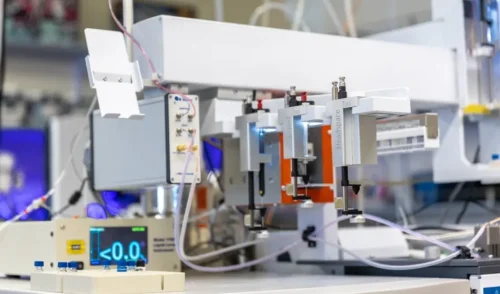
Cooling is essential in modern life, from keeping food fresh to running data centers, but traditional refrigeration comes at a high environmental cost. It consumes large amounts of electricity and contributes significantly to global carbon emissions. Solid-state cooling has long been considered a greener alternative, but it has struggled in practice due to poor heat transfer, making it inefficient at scale.
Researchers at the Chinese Academy of Sciences have developed a new cooling method that addresses this problem, offering a potential path to zero-emission refrigeration. By combining solid cooling effects with liquid flow, their technique solves a major hurdle in solid-state systems: transferring heat efficiently.
The team, led by Prof. Li Bing, discovered that the salt ammonium thiocyanate releases heat when it dissolves in water. Applying pressure reverses the process, making the salt precipitate again. This cycle can repeat continuously, allowing cooling whenever pressure is applied and released. Unlike conventional solid-state methods, this approach merges the refrigerant and heat-transfer medium into a single flowing liquid, enabling both strong cooling and efficient heat movement.
Lab tests show the system can drop temperatures by nearly 30 kelvins in just 20 seconds at room temperature, and up to 54 kelvins at higher temperatures. Prototype simulations indicate a cooling capacity of 67 joules per gram and an efficiency near 77 percent. The process is stable, reversible, and responds instantly to pressure changes—key traits for real-world refrigeration systems that need reliability over long periods.
By turning the coolant into a pumpable fluid, the method simplifies cooling system design, eliminating the inefficiencies of gas compression or traditional solid-phase changes. This makes it suitable for industrial facilities, homes, and high-demand environments like AI data centers, where managing intense heat efficiently is critical.
This breakthrough addresses the “impossible triangle” of solid-state cooling—balancing low emissions, high cooling power, and efficient heat transfer—while providing a practical, scalable path to zero-carbon refrigeration.