





The unit combines low-noise sensing, temperature compensation, and synchronised data output to improve positioning accuracy and navigation reliability, particularly during GNSS signal interruptions.
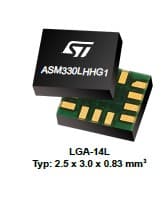
Automotive and industrial vehicle manufacturers are gaining access to a new inertial measurement unit (IMU) by STMicroelectronics designed to improve positioning precision and motion sensing in applications that rely on satellite navigation and dead reckoning. The six-axis sensor integrates a three-axis accelerometer and a three-axis gyroscope, delivering synchronised motion data that supports more accurate dead-reckoning calculations and sensor fusion. The device is aimed at addressing growing demand for reliable positioning in vehicles, especially when GNSS signals become unavailable, degraded, or corrupted.
The key features are:
- 6-axis IMU with 3-axis accelerometer and 3-axis gyroscope
- Synchronized sensor output for improved dead-reckoning and GNSS fusion
- Operating temperature range of -40°C to 125°C
- Accelerometer range up to ±16g and gyroscope range up to ±4000 dps
- Dual power modes, 3KB FIFO, and support for I²C, SPI, and MIPI I3C interfaces
As advanced navigation, routing, tracking, and driver-assistance systems become increasingly dependent on precise location data, maintaining continuity between satellite updates has become critical. The new IMU helps bridge these gaps by providing stable, low-noise motion data with built-in temperature compensation, enabling consistent performance across varying operating conditions. Designed for automotive environments, the sensor operates over a temperature range of -40°C to 125°C, enabling deployment in multiple vehicle zones where elevated ambient temperatures are a concern. The device leverages the latest MEMS manufacturing technologies to reduce sensor noise while improving long-term stability.
Beyond navigation, the IMU can support a broad range of vehicle applications including vehicle-to-everything (V2X) communications, telematics, electronic tolling systems, anti-theft monitoring, impact detection, crash reconstruction, vibration analysis, and motion-triggered functions. The accelerometer supports measurement ranges up to ±16g, while the gyroscope offers selectable ranges from ±125 dps to ±4000 dps with low bias drift.To accommodate varying power requirements, the sensor includes both high-performance and low-power operating modes. Integration is simplified through support for I²C, SPI, and MIPI I3C interfaces, while an integrated 3KB FIFO buffer reduces host processor workload and contributes to lower system power consumption.
Qualified to AEC-Q100 automotive standards, the IMU is now in production and is supplied in a compact 2.5mm × 3.0mm LGA package, targeting next-generation connected, autonomous, industrial, and agricultural vehicle platforms.

