Automotive boost controller with SPI programmability enables efficient multi-phase power design for next-generation adaptive lighting systems.
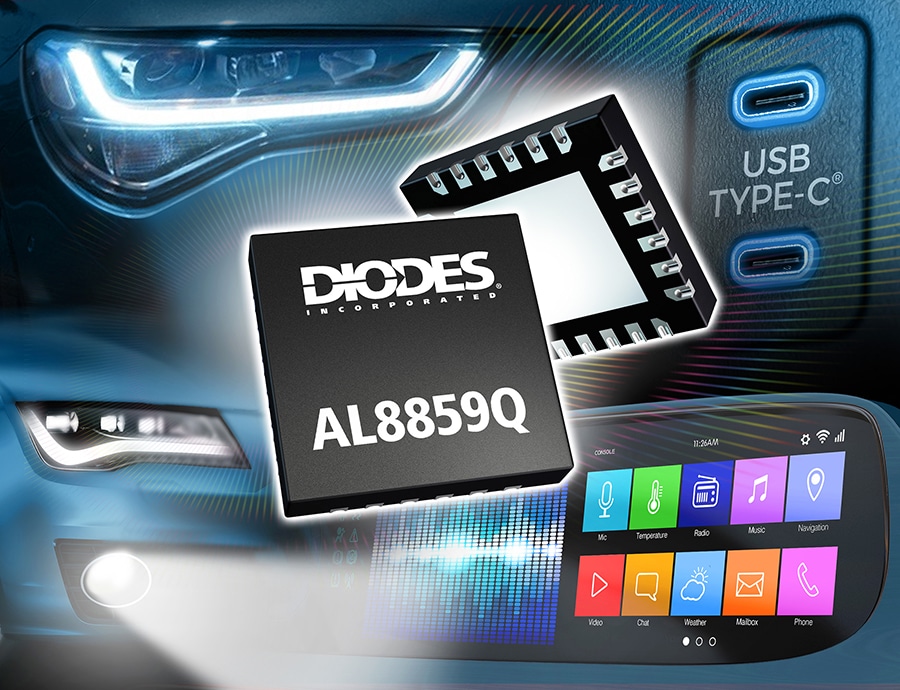
A new automotive-grade multi-phase boost controller by Diodes Incorporated aims to simplify the design of high-power headlight systems while improving efficiency and reliability in modern vehicles. Introduced by Diodes Incorporated, the device is designed as a constant-voltage pre-stage for adaptive automotive lighting modules.
Advanced lighting systems such as adaptive front lighting, high and low beams, daytime running lights (DRL), fog lamps, and turn indicators are increasingly being integrated into a single lighting module. These systems require compact, high-efficiency power architectures capable of handling high output power while maintaining thermal stability and meeting strict automotive electromagnetic interference (EMI) standards.
The key features are:
- Wide input range: 4.5 V to 60 V supporting 5 V, 12 V, 24 V, and 48 V systems
- Multi-phase boost architecture scalable to 2–4 phases for 100 W–400 W power
- SPI programmable control for voltage, frequency, and protection settings
- ~95% system efficiency with balanced thermal distribution
- Integrated diagnostics and protection including thermal, voltage, and current monitoring
The new controller addresses these requirements through a current-mode multi-phase boost architecture that supports a wide input voltage range from 4.5V to 60V. This allows the controller to operate across common automotive supply rails including 5V, 12V, 24V, and emerging 48V systems. The architecture also improves resilience during load-dump events and transient conditions by enabling programmable output voltage control through internal registers.
Each device supports two boost phases, while higher-power designs can synchronize multiple controllers to create three- or four-phase configurations. This scalable approach enables systems delivering roughly 100W to 400W of output power, while distributing thermal load and reducing ripple current to maintain system efficiency close to 95%.
Configuration and control are handled through an SPI interface, allowing designers to program parameters such as switching frequency, current limits, output voltage, and protection thresholds. The programmable architecture allows the same hardware platform to support multiple vehicle lighting configurations with minimal redesign.
To support reliability and functional safety requirements, the controller integrates extensive diagnostic capabilities including thermal warning and shutdown, overvoltage and undervoltage protection, current limiting, SPI communication error detection, and drive voltage monitoring. Integrated one-time programmable memory also enables production-line configuration and allows the device to operate independently of a microcontroller in fail-safe scenarios.To help designers meet automotive EMC standards, the controller uses spread-spectrum frequency modulation to reduce electromagnetic emissions and simplify compliance with CISPR 25 Class 5 limits. The device is packaged in a compact 4 mm × 4 mm wettable-flank QFN package that supports automated optical inspection during manufacturing.