A new study shows how ultrafast laser pulses can control quantum uncertainty, enabling faster, more secure communication and improving future quantum network design.
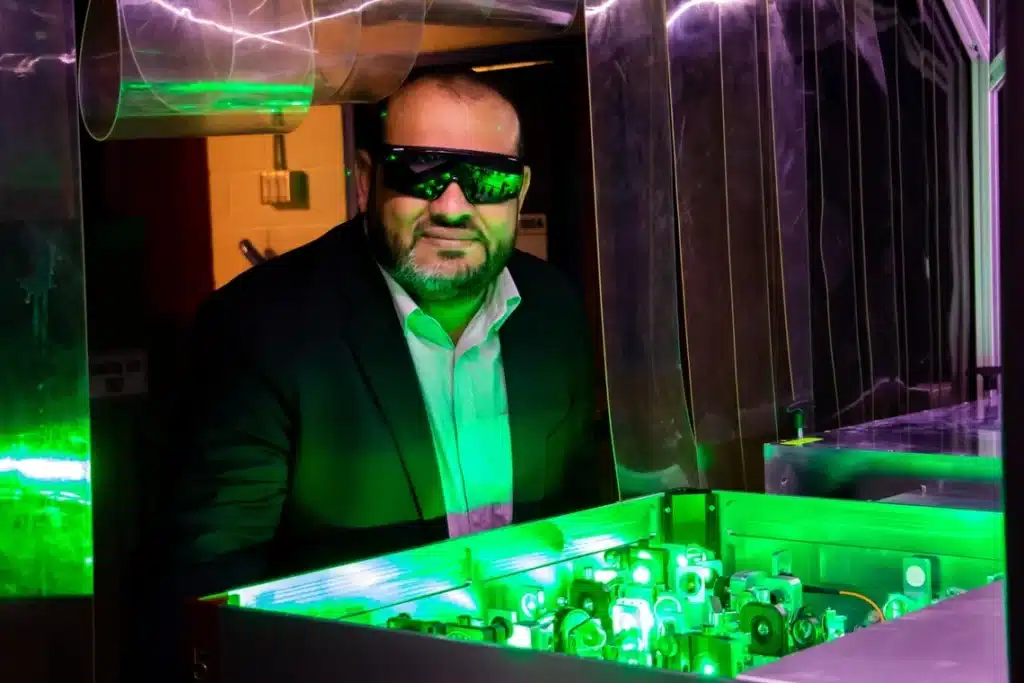
Using ultra fast light, researchers demonstrate capturing quantum uncertainty in real time. This shows how managing quantum uncertainty makes data transmission more secure and improves the performance of quantum systems.
Quantum uncertainty is a principle in quantum physics that limits how precisely two related properties of light, such as its position and intensity, can be known at the same time.
This limit shapes how information behaves at the subatomic level. Controlling it allows more accurate detection and transmission of signals, forming the basis for secure quantum communication.
The team uses a process known as four-wave mixing, where multiple light beams interact to generate new frequencies. A single laser is divided into three identical beams and directed into fused silica. By adjusting the angle of the silica, the researchers control whether the photon’s intensity or phase is reduced in uncertainty.
This is achieved using ultrafast laser pulses that last only femtoseconds, one quadrillionth of a second. These short bursts of light enable faster measurement and control of quantum effects, increasing both precision and speed in optical systems.
These ultra fast lights are called “squeezed light”, a form of light where uncertainty in one property is reduced while it increases in another. This adjustment allows scientists to measure one aspect of light more accurately. It is also used in secure quantum networks, where even the smallest interference can be detected immediately.
This marks the first demonstration of ultrafast squeezed light and real-time control of quantum uncertainty. The development combines ultrafast laser science and quantum optics, opening the field of ultrafast quantum optics, with applications in secure communication, quantum sensing and precision diagnostics.