Can we trace how matter formed after the Big Bang? A new detector has taken a step toward the answer.
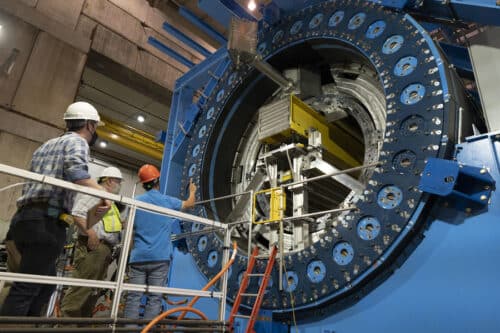
Studying the earliest state of the universe has been limited by how precisely scientists can measure short-lived forms of matter. A new particle detector called sPHENIX, developed by more than 300 scientists worldwide and now operating at Brookhaven National Laboratory, has cleared a milestone showing it can address this challenge.
The detector is built to study quark gluon plasma, a state of matter that existed just after the Big Bang. This plasma, made of quarks and gluons, lasts only a fraction of a second before cooling into protons and neutrons. Because it disappears quickly, researchers can only infer its properties by measuring the particles created as it decays. Earlier detectors did not have the speed or precision needed to capture these details.
sPHENIX, running at Brookhaven’s Relativistic Heavy Ion Collider, has shown it can make these measurements. In its first test, the detector recorded the number and energy of particles produced when gold ions collided near light speed. The results showed that head-on collisions created about 10 times more particles, each carrying about 10 times more energy, than glancing ones. This confirmed the detector’s accuracy against a known benchmark.
The milestone allows sPHENIX to study how quark gluon plasma evolves and behaves. By tracing the particles from collisions, researchers aim to reconstruct its properties, including density, energy flow, and how particles move through dense matter. These results could provide a clearer picture of conditions in the first moments of the universe.

The detector is an upgrade over its predecessor. Installed in 2021, it can record up to 15,000 collisions per second. Its micro vertex tracker acts as a 3D camera, allowing scientists to follow particle paths with high resolution.
The first test was conducted in late 2024 and confirmed that the system is precise and reliable. With extended runs now underway, the sPHENIX Collaboration, which includes researchers from MIT and other institutions worldwide, is beginning to use the detector to study rare processes that were not possible before, offering new insights into the building blocks of matter.