




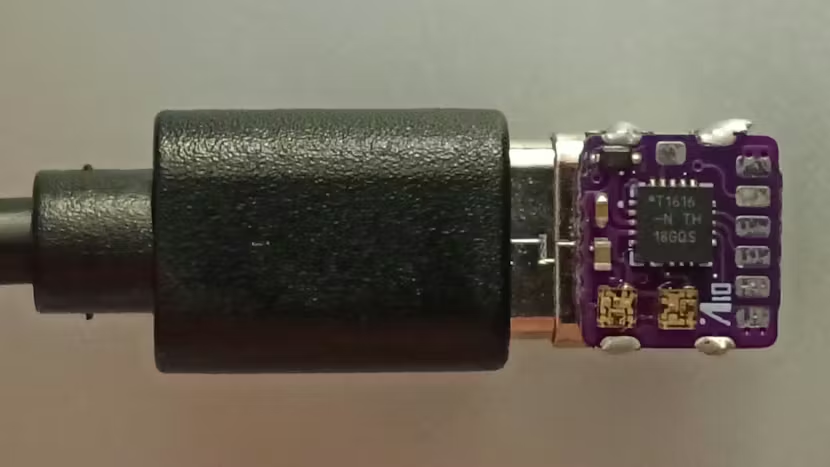
This development board is built for ultra-compact projects, but is hardly larger than its own USB-C port!
A wide range of microcontroller development boards exists for different project requirements. High-performance options include the Teensy microcontroller boards and the Raspberry Pi Pico. Applications requiring a large number of GPIO pins can utilize boards such as the Clintech Pico. Size constraints in wearable and embedded designs create demand for significantly smaller hardware solutions.
The AngstromIO microcontroller board addresses ultra-compact design requirements with dimensions of 9.0 × 8.9 mm. Form factor approaches the size of a USB-C connector, enabling integration into highly space-limited systems. Design emphasis prioritizes minimal footprint over high processing performance. Open-source availability includes schematics, PCB layouts, and firmware resources.
Core architecture features the Microchip ATtiny1616 microcontroller, an 8-bit MCU operating at frequencies up to 20 MHz with 16 KB of flash memory. Capability supports sensor interfacing, basic control logic, and low-power embedded operations. Power consumption reaches approximately 200 nA in power-down mode, enabling suitability for battery-operated and continuous-operation applications.
Hardware integration includes two addressable RGB LEDs (SK6805) for onboard visual indication. Exposed pads provide access to I2C communication lines (SDA, SCL), UART transmission, GPIO pins, and power rails. USB-C interface supplies 5V input exclusively, maintaining compact design constraints while requiring external programming hardware.
Programming utilizes a UPDI interface. Compatibility with the Arduino IDE is enabled through SpenceKonde’s megaTinyCore, supporting standard libraries for I2C communication and addressable LED control. A supplementary dual-programmer module based on CH340E chips provides UPDI programming functionality and serial debugging capability, enabling real-time firmware monitoring.
Open-source distribution supports replication and customization of ultra-miniature development board designs for embedded systems, wearable electronics, and space-constrained applications.
Click here for more information.


