A current sensor sends digital signals instead of analog ones to improve measurement accuracy in high-power electric vehicle systems.
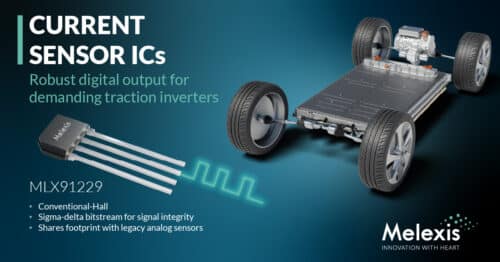
Melexis has launched the MLX91229, a Hall-effect current sensor with a sigma-delta digital output for automotive applications. The device measures currents from 200 A to 2000 A and is designed for traction inverters and other vehicle systems where electrical noise can affect current sensor signals.
The sensor transmits current measurements as a sigma-delta digital bitstream instead of an analog voltage signal. This reduces the effect of electromagnetic interference (EMI) between the sensing element and the microcontroller (MCU), helping maintain signal quality during transmission.
The hall-effect current sensor is intended for electric vehicle powertrains using higher-voltage architectures and silicon carbide (SiC) and gallium nitride (GaN) power devices. These systems generate more electromagnetic noise, making it harder for analog current sensors to maintain signal quality, especially where longer PCB traces or wiring are used.
In analog current sensing, the measured current is represented by small voltage changes that can be affected by electrical noise. The sensor instead encodes the measured current into a sigma-delta bitstream, where the information is carried by the density of digital pulses. This allows the signal to tolerate disturbances along the transmission path before it reaches the MCU.

The sensor uses the same footprint as existing analog Hall-effect current sensors, allowing engineers to evaluate digital current sensing without changing the PCB layout. Its sigma-delta output also allows engineers to choose different demodulation methods based on bandwidth, noise, and response time requirements.
The current sensor is based on technology already used in industrial applications and is now available for automotive and mobility systems, adding a digital output option to Melexis’ current sensing portfolio.
Click here for the original announcement.