




A millisecond light-flash process transforms semiconductor crystal structures while keeping the underlying glass cool, opening new possibilities for solar cells and advanced electronics.
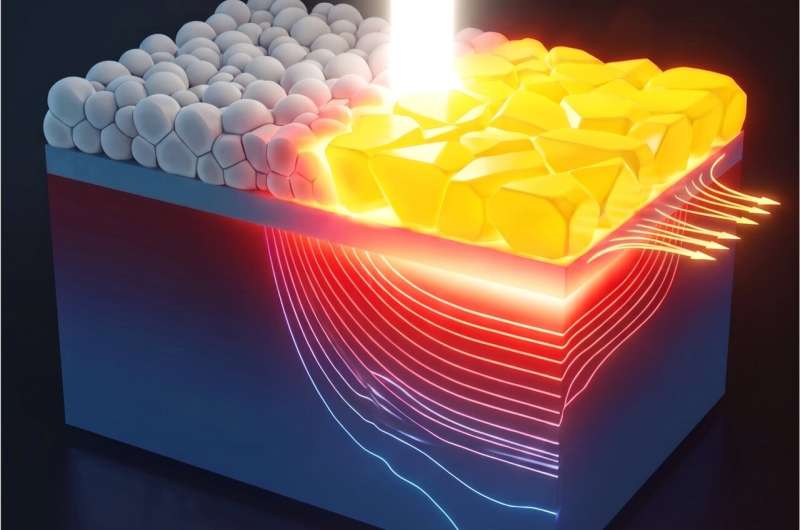
Researchers at the Hebrew University of Jerusalem have developed a light-based method for altering the crystal structure of semiconductor films without exposing their underlying substrates to damaging temperatures. The technique could help manufacture higher-performance materials for solar-energy conversion and other electronic devices, particularly where conventional high-temperature processing is impractical.
The process, called flash photonic heating, uses extremely short, intense pulses of white light to heat a thin semiconductor coating almost instantaneously. In experiments with bismuth oxide, the film reached nearly 2,000°C, while the transparent conducting glass underneath remained below 100°C. This separation is important because the glass and its conductive coating can tolerate only substantially lower temperatures, preventing conventional furnaces from producing or preserving certain useful material structures.
The key innovation is not changing the material’s chemical composition but controlling how its atoms are arranged. Bismuth oxide can form different crystal structures, or polymorphs, with significantly different optical and electrical properties.
Conventional heating tends to produce the stable alpha phase. When the material is heated and cooled extremely rapidly, however, researchers can trap the less stable beta phase at room temperature. Pulse duration and intensity determine which structure forms, showing that the speed at which energy is delivered can be more important than the total energy supplied.
The researchers achieved heating rates of up to 10 million degrees Celsius per second using pulses lasting roughly a fraction of a millisecond to a few milliseconds. Because the semiconductor film absorbs the light directly, it heats and cools much faster than the glass substrate beneath it. This effectively allows the researchers to create a high-temperature environment within the thin film without overheating the supporting surface.
The resulting beta-phase bismuth oxide absorbed more visible light than the conventional alpha phase and generated 10 to 50 times more photocurrent, depending on how the films were prepared. Researchers attribute the improvement partly to more effective movement of electrical charges through the altered crystal structure.
The team also demonstrated reversible switching between the two crystal phases directly on transparent conducting glass. That capability could be significant for electronic and photoactive devices because it suggests that material properties can potentially be tuned without replacing the underlying component.
The immediate focus is solar-energy conversion, but the approach could extend to photocatalysis and advanced semiconductor devices. Researchers are also investigating whether flash heating can be adapted to plastic and flexible substrates, potentially broadening its use in next-generation flexible electronics.
