Chinese researchers have embedded full computing circuits into stretchable fibers thinner than a human hair, opening new possibilities for smart textiles, wearables, and biomedical electronics.
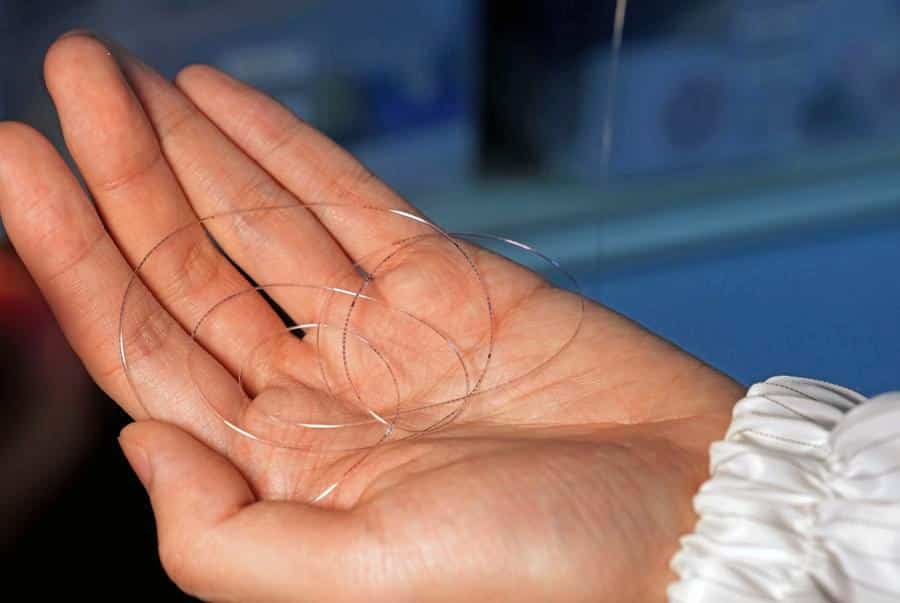
Chinese researchers have achieved a major milestone in flexible electronics by embedding complete computing systems—including processors, memory, and signal-processing units—into polymer fibers thinner than a strand of human hair. The advance, reported by a research team at Fudan University and published in Nature, could fundamentally change how electronics are integrated into clothing, medical devices, and human–machine interfaces.
Until now, most flexible and wearable electronics have relied on attaching rigid silicon chips onto soft substrates, limiting comfort, durability, and design freedom. The Fudan team addressed this challenge by developing a novel fiber-based architecture that allows complex microelectronic circuits to be built directly inside elastic fibers. Using a fabrication method inspired by sushi-roll structures, the researchers first created an ultra-flat nanoscale surface within a stretchable polymer sheet. Standard lithography techniques were then used to fabricate high-precision circuits on this surface before it was tightly rolled into a cylindrical fiber.
The resulting “fiber chips” achieve transistor densities of around 100,000 per centimeter, approaching the complexity of conventional microprocessors. Despite their extreme thinness and softness, the fibers maintain stable performance under repeated bending, stretching, and compression. In experimental demonstrations, the embedded circuits were able to process both digital and analog signals and even perform basic neural-network tasks such as image recognition, indicating that the technology goes well beyond simple sensing.
This shift from flat, rigid chips to thread-like computing elements opens the door to electronics that can be woven directly into fabrics or integrated seamlessly with biological tissue. In smart clothing, such fibers could enable garments that continuously monitor health metrics, display information, or interact with digital systems without bulky modules. In immersive technologies, they could support gloves or suits with distributed sensing and feedback for virtual and augmented reality. The fibers’ softness and small size also make them promising for brain–computer interfaces and other biomedical implants, where mechanical compatibility with tissue is critical.
Importantly, the approach is compatible with existing semiconductor manufacturing processes, suggesting a clearer path toward large-scale production than many experimental soft-electronics concepts. By turning ordinary fibers into computing platforms, the work signals a step toward electronics that are no longer confined to chips and boards, but embedded directly into the materials people wear and interact with every day.