New computational holography algorithms cut processing time by over half and enable multi-depth augmented reality displays, a key step toward smarter head-up systems and next-gen electronics interfaces.
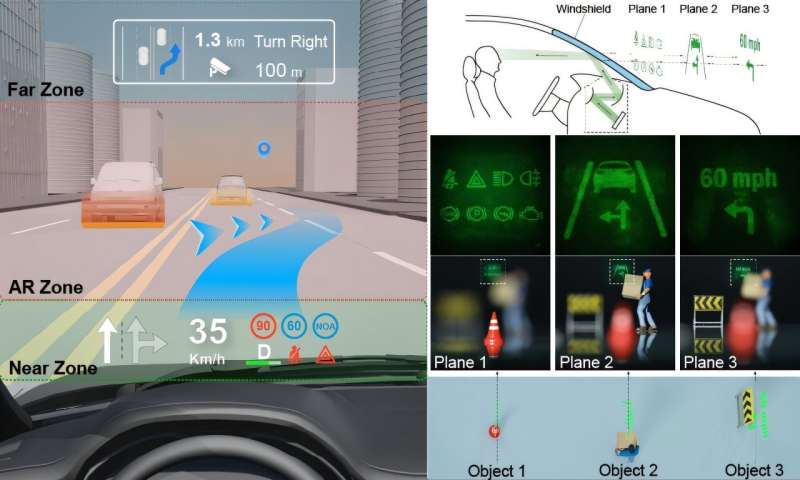
A team of researchers has unveiled a more efficient holographic computation technique that could accelerate development of advanced augmented-reality (AR) displays in electronics, especially vehicle head-up displays (HUDs) that overlay digital data directly into a driver’s view. Their approach significantly trims calculation time and memory demands compared with conventional hologram methods, opening the door for richer, real-time mixed-reality interfaces.
The core innovation replaces traditional fast Fourier transform (FFT) frameworks with a matrix multiplication (MM)-based diffraction method that eliminates the need for “zero-padding”a workaround that bloats computation when projecting virtual images onto large surfaces like a windshield. Results showed about 58 % reduction in calculation time and much lower memory usage, making practical holographic processing feasible for embedded automotive and wearable systems.
In prototype tests, researchers built an AR-HUD system that projected three distinct virtual images at different depths (0.1 m, 0.5 m and 1.5 m) simultaneously, aligning perfectly with physical objects such as traffic cones and construction workers in the vehicle’s path. Because the MM approach handles extreme size differences and both near-field and far-field content in a single computational framework, it promises flexible multi-plane displays without bulky optics or excessive hardware.
This breakthrough is especially relevant for next-generation automotive and smart windshield technologies, where safety-critical alerts (speed, navigation cues, obstacle warnings) must appear seamlessly integrated into the real world without eye-strain or distraction. By improving efficiency, the algorithm could enable HUDs with wider fields of view and faster refresh rates while reducing power consumption in embedded electronics.

Beyond vehicles, the computational method has broader implications for any AR/VR and wearable display system that relies on holographic optics, an area rapidly evolving in consumer tech, spatial computing, and smart glasses. With continued refinement of color fidelity and dynamic refresh performance, this approach marks a practical step toward compact, high-performance holographic displays in both automotive and general electronics markets.