

Researchers in China could reshape how future 6G networks operate—using holography-inspired, cable-free intelligent surfaces that sense, adapt, and beam wireless signals autonomously.
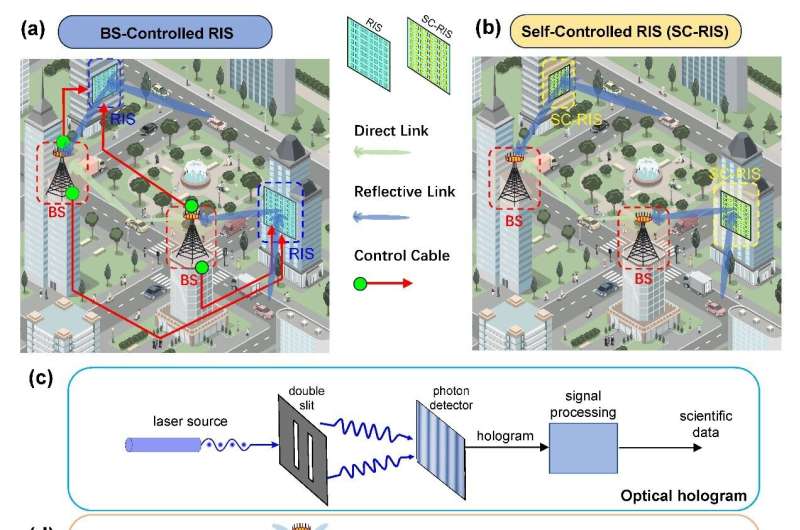
Wireless communication is stepping into a new era of intelligence, researchers at Tsinghua University and Southeast University. The team has developed a self-adaptive reconfigurable intelligent surface (RIS) that draws inspiration from optical holography—offering a way to control wireless signals without relying on base stations or wired connections.
Traditional RIS setups work like programmable mirrors, redirecting electromagnetic waves to improve signal coverage. However, they typically depend on cables and centralized base-station control, which limits flexibility and scalability. The new design breaks from this model entirely. Instead of connecting each meta-atom—the tiny unit that manipulates waves—to a control center, the surface uses low-cost radio-frequency power detectors to sense the environment directly.
Much like how holography records and reconstructs light patterns, this RIS captures interference patterns from coherent microwave signals emitted by both the base station and the user device. These patterns reveal spatial information that allows the surface to “understand” where the user is located. Once it identifies the position, each meta-atom adjusts its reflective phase on its own, steering the signal toward the user automatically. The result is a self-contained, plug-and-play surface that can enhance wireless communication without extra infrastructure.
This holography-based approach has the potential to transform next-generation wireless networks, particularly as 6G moves toward ultra-dense, adaptive environments. By removing the need for cables and complex control systems, deployment becomes faster and more cost-efficient. Moreover, the autonomous design allows the system to adapt dynamically, maintaining strong connections even as users move or network conditions shift.
The research team now aims to scale this concept further by coordinating multiple self-controlled RIS units to serve many users at once—a key challenge for real-world 6G applications. If successful, this technology could make the wireless environment itself an intelligent, responsive participant in communication rather than a passive medium—ushering in a new era of holographic, self-managing connectivity.