




A pea-sized liquid-metal pump enabling ultra-low-voltage soft robots with butterfly wings, wearable haptics, and adaptive motion, potentially transforming compact robotics, biomedical devices, and next-generation flexible electronic systems.
A pea-sized liquid-metal pump that operates at ultra-low voltage is emerging as a breakthrough in soft robotics, enabling a new class of miniature, flexible machines that mimic biological motion and sensory feedback. The system, developed by researchers and published in Nature Communications, uses a magnetohydrodynamic mechanism to convert electrical energy into fluid motion, acting as a compact “heart” for soft robotic structures.
At just about 0.2 grams and functioning below 0.1 volts, the liquid-metal-based actuator challenges conventional pneumatic and rigid pump systems that typically rely on bulky compressors or high-voltage components. Instead, it leverages the intrinsic properties of liquid metal—high conductivity, deformability, and surface tension—to generate controlled fluid flow inside soft systems. The result is efficient actuation at millivolt-to-sub-volt levels, significantly reducing power and size constraints in robotics.
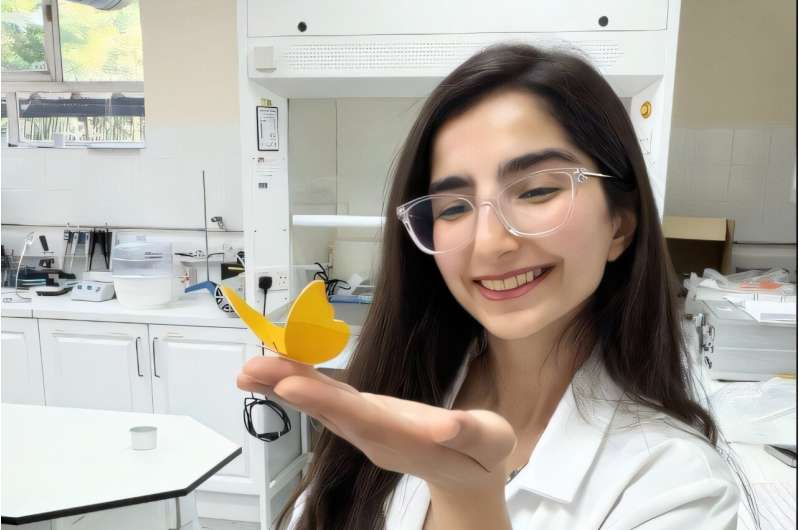
Researchers demonstrated the technology through multiple prototypes, including a robotic butterfly with flapping wings, a color-changing wearable bracelet, and a haptic fingertip device that simulates touch sensations through fluid pressure. These applications highlight how the same pump architecture can support both motion and sensory feedback in compact, integrated systems.
Unlike traditional soft robotics that depend on external compressors or rigid actuators, the liquid-metal pump enables fully embedded actuation, opening possibilities for autonomous wearable systems, lab-on-chip devices, and minimally invasive biomedical tools. The pump also supports energy transfer and signal transmission within soft fluidic networks, allowing multiple functions—pumping, sensing, and communication—to coexist in a single structure.
A key mechanism behind the system is the Lorentz force, generated when electric current passes through liquid metal in a magnetic field, driving controlled oscillations and fluid displacement. This physical principle allows precise motion control without mechanical gears or motors.
Researchers believe the technology could serve as a foundational platform for next-generation soft robots that are lightweight, adaptive, and capable of interacting safely with humans and delicate environments. Potential future applications include wearable robotics, environmental sensing systems, and advanced medical diagnostics.
With its combination of ultra-low power operation, extreme miniaturization, and multifunctional capability, the liquid-metal pump represents a significant step toward fully integrated soft robotic ecosystems that blur the line between electronics and biology.


