




HomeElectronics NewsNASA Develops Probes To Measure Supersonic Shock Waves

NASA Develops Probes To Measure Supersonic Shock Waves

NASA’s new probes will measure shock waves from the X-59, helping refine supersonic flight models to reduce noise and improve accuracy in future tests.
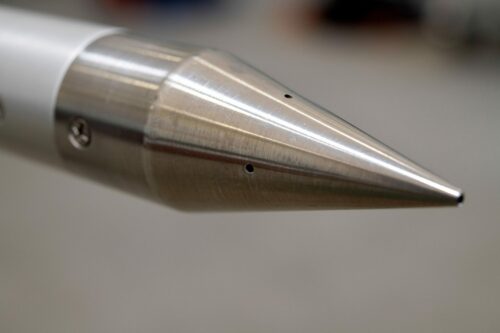
A close-up of NASA’s shock-sensing probe highlights its pressure ports, designed to measure air pressure changes during supersonic flight. The probe will be mounted on NASA’s F-15B Aeronautics Research Test Bed for calibration flights, validating its ability to measure shock waves generated by the X-59 as part of NASA’s Quesst mission to provide data on quiet supersonic flight. Credit: NASA/Lauren Hughes

NASA is preparing to test enhanced tools for measuring the quieter sonic thumps produced by its X-59 supersonic aircraft. These tools include a shock-sensing probe to gather detailed pressure data from shock waves during supersonic flight.

- Advertisement -

Researchers at NASA’s Armstrong Flight Research Center in Edwards, California, have developed two versions of the probe to capture precise pressure data during supersonic flight. One version is optimized for near-field measurements, capturing shock waves close to the aircraft’s source, while the other is designed for mid-field measurements, collecting data at altitudes between 5,000 and 20,000 feet below the X-59.

The probes’ ability to detect small pressure changes is crucial for the X-59, as its shock waves are expected to be significantly weaker than most supersonic aircraft. Researchers can more accurately evaluate their effectiveness by comparing the data from the probes to predictions from advanced computer models.

The probes feature five pressure ports—one at the tip and four around the cone—that measure static pressure changes as the aircraft moves through shock waves. These measurements help researchers understand the shock characteristics of the aircraft. The data from the ports are combined to calculate the airflow’s local pressure, speed, and direction.

- Advertisement -

Temperature sensitivity in previous designs posed a challenge, leading to fluctuations in accuracy due to changing conditions. To address this, the team developed a heating system that keeps the pressure transducers at a consistent temperature during flight.

Researchers are preparing to test upgrades to the near-field shock-sensing probe during upcoming test flights. The probe, mounted on one F-15B, will collect data while following a second F-15 in a supersonic flight. The upgrades include positioning the probe’s pressure transducers—devices that measure air pressure on the cone—just 5 inches from the ports, a significant improvement over previous designs that placed the transducers nearly 12 feet away. This change reduces delays in recording time and minimizes measurement distortion.


Nidhi Agarwal
Nidhi Agarwal
Nidhi Agarwal is a Senior Technology Journalist at Electronics For You, specialising in embedded systems, development boards, and IoT cloud solutions. With a Master’s degree in Signal Processing, she combines strong technical knowledge with hands-on industry experience to deliver clear, insightful, and application-focused content. Nidhi began her career in engineering roles, working as a Product Engineer at Makerdemy, where she gained practical exposure to IoT systems, development platforms, and real-world implementation challenges. She has also worked as an IoT intern and robotics developer, building a solid foundation in hardware-software integration and emerging technologies. Before transitioning fully into technology journalism, she spent several years in academia as an Assistant Professor and Lecturer, teaching electronics and related subjects. This background reflects in her writing, which is structured, easy to understand, and highly educational for both students and professionals. At Electronics For You, Nidhi covers a wide range of topics including embedded development, cloud-connected devices, and next-generation electronics platforms. Her work focuses on simplifying complex technologies while maintaining technical accuracy, helping engineers, developers, and learners stay updated in a rapidly evolving ecosystem.

SHARE YOUR THOUGHTS & COMMENTS

EFY Prime

Unique DIY Projects

Electronics News

Truly Innovative Electronics

Latest DIY Videos

Electronics Components

Electronics Jobs

Calculators For Electronics
