

Durable enough to survive 30-meter drops and versatile across land and water, these miniature machines could soon be on rescue missions, exploring caves, or performing delicate medical tasks.
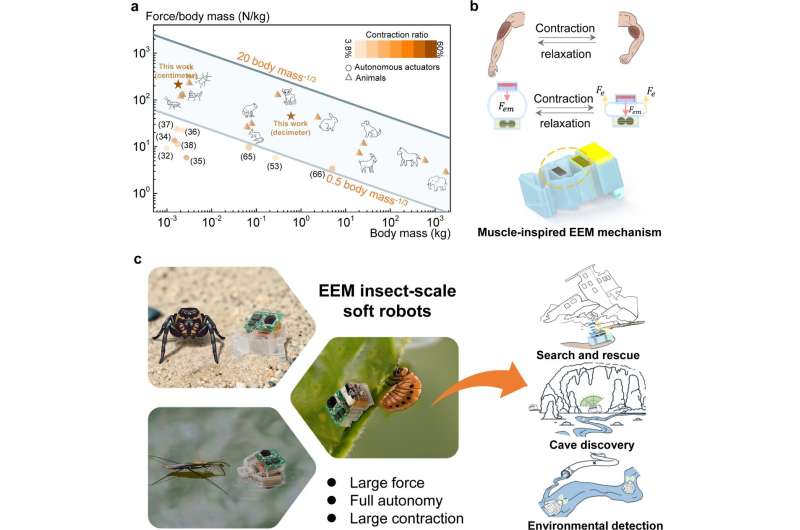
Researchers have drawn inspiration from the mollusk’s catch muscle — a natural marvel that can hold position with almost no energy — to tackle one of soft robotics’ biggest challenges: creating insect-scale robots that move autonomously without sacrificing power, precision, or durability. Their breakthrough, detailed in Nature Communications, introduces a muscle-inspired elasto-electromagnetic (EEM) actuator capable of powering tiny robots to crawl, swim, and jump without bulky motors or continuous energy draw.
The actuator is made from soft elastomeric polymers embedded with an electrical coil and miniature magnets, enabling it to mimic the bistable locking ability of mollusk muscles.
This means it can hold its position without consuming energy, greatly improving efficiency and allowing small robots to operate for longer periods in remote or hazardous locations without frequent recharging. Energy savings at this scale open the door to longer missions and more autonomous field operations.
Durability is another standout feature. Unlike rigid motors that can break easily, the EEM actuator’s flexible, soft construction can withstand millions of movement cycles and survive drops from up to 30 meters without damage. This resilience makes the technology reliable in rugged terrains — from rocky surfaces and debris-laden disaster zones to underwater environments — making it ideal for high-stakes applications like search and rescue.
To prove its versatility, the research team built several insect-sized robots equipped with the new actuator. These bots successfully navigated soil, stone, and glass, swam in both lab tanks and rivers, and even completed obstacle courses while performing sensing operations. A single actuator type powering such a variety of movements means that one technology can be adapted for multiple missions, from disaster-site inspection to underwater exploration, reducing development costs and enabling rapid deployment.
Looking ahead, the team sees potential uses in rescue missions, hazardous site inspections, cave exploration, and even minimally invasive medical tools. By combining agility, strength, and autonomy at insect scale, these muscle-powered robots could redefine how small machines operate in both everyday and extreme scenarios. They may be tiny, but with nature’s blueprint as their guide, they are set for big adventures.