





The chip, featuring both chemitransistors and memtransistors, demonstrates potential for precise chemical classification.
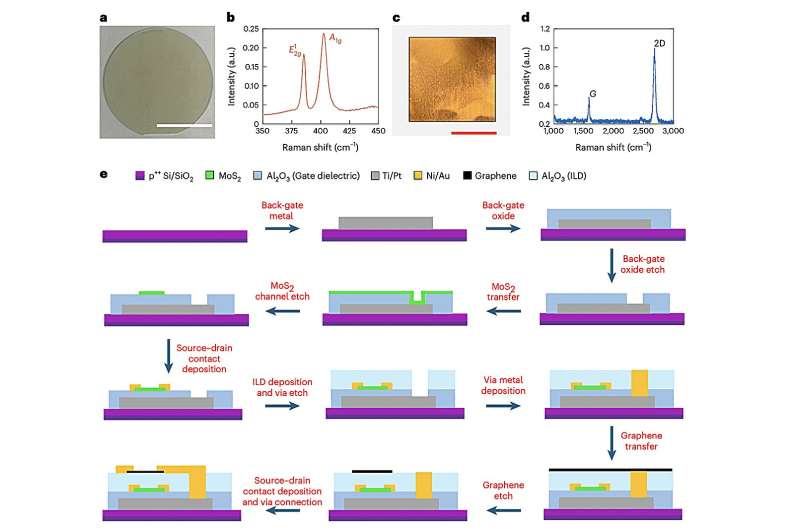
Researchers at Pennsylvania State University have developed compact near-sensor computing chips using a method known as monolithic 3D (M3D) integration, which enables transistors to be constructed layer by layer on the same substrate. This approach is gaining traction in the semiconductor industry as a promising alternative to traditional through-silicon via (TSV) technology. It allows for a denser arrangement of electronic components, enhancing both the performance and efficiency of circuits. The team’s study, presents a new chip that leverages M3D integration to achieve high-density, heterogeneous electronics.
The chip combines over 500 chemitransistors and over 500 memtransistors, organized in tiers with vertical interconnects spaced at distances as small as 1 μm. Their M3D stack integrates graphene-based chemisensors in one layer and molybdenum disulfide (MoS2) memtransistor circuits in another, reducing the physical separation between sensors and computing elements to 50 nm. This proximity aims to enhance the chip’s performance in near-sensor computing applications by reducing latency.
One of the significant features of the researchers’ approach is that the entire fabrication process occurs at temperatures below 200°C, which aligns with current back-end-of-line (BEOL) integration processes in semiconductor manufacturing. This compatibility with established processes supports the scalability and potential industrial adoption of M3D-integrated chips. In their study, the researchers demonstrated the chip’s potential by designing an alert system for chemical identification. Using their chip, they exposed chemitransistors to different concentrations of sugar solutions, which generated electrical signals that were processed by memtransistors. This process translated the signals into analog and digital codes, effectively classifying the chemicals based on the chemitransistors’ responses.
The study’s results underline the possible applications of this M3D-integrated chip in chemical processing and classification tasks. Future developments may extend these capabilities, enabling chips with even greater numbers of circuits and sensors to handle more complex classification challenges.

