



Researchers developed a silver-containing zeolite that efficiently separates hydrogen isotopes, offering a promising pathway towards improved fusion fuel recycling and future reactor performance.
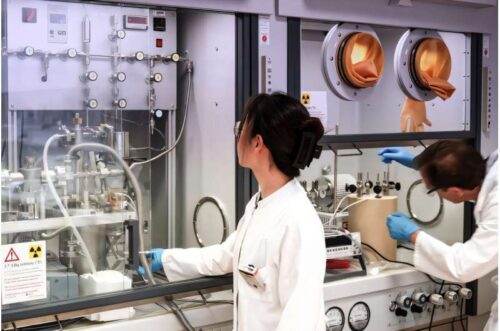
The Helmholtz-Zentrum Dresden-Rossendorf (HZDR), together with partners including Leipzig University, has developed a silver-containing zeolite that offers a highly efficient method for separating hydrogen isotopes used in fusion energy. Published in Nature Communications, the research could improve future fusion fuel cycles by enabling more effective recovery, separation and reuse of deuterium and tritium.
Fusion reactors generate energy by fusing deuterium and tritium, but not all of the fuel is consumed during operation. The remaining mixture also contains ordinary hydrogen, known as protium, making efficient isotope separation essential before the fuel can be recycled. Existing separation methods struggle because the isotopes behave almost identically in chemical reactions despite their different atomic masses.
The research team addressed this challenge using a silver-exchanged zeolite, a porous material whose microscopic cavities contain silver ions. Interactions between hydrogen molecules and the electronic structure of these silver ions create an adsorption potential that binds each isotope with different strengths. As a result, protium, deuterium and tritium are released from the material at different temperatures, enabling efficient separation in a single processing step.
Laboratory experiments involving radioactive tritium confirmed the material’s effectiveness and provided experimental validation of theoretical predictions regarding isotope behaviour. Researchers also found that exposure to tritium caused no measurable decline in the material’s separation performance, suggesting encouraging stability under demanding conditions.
Although the work remains at a fundamental research stage, the findings establish an important foundation for future fusion fuel processing technologies. Before industrial deployment, scientists must investigate larger-scale processing, long-term durability and overall system scalability. The team also plans to apply the same separation principles to other porous materials, aiming to identify even more efficient approaches for isolating chemically similar hydrogen isotopes and supporting the development of practical fusion energy systems.

