




A new high-density tactile sensor array enables four-legged robots to balance and transport unsecured objects, marking a major step toward practical home, industrial and outdoor robotic assistants.
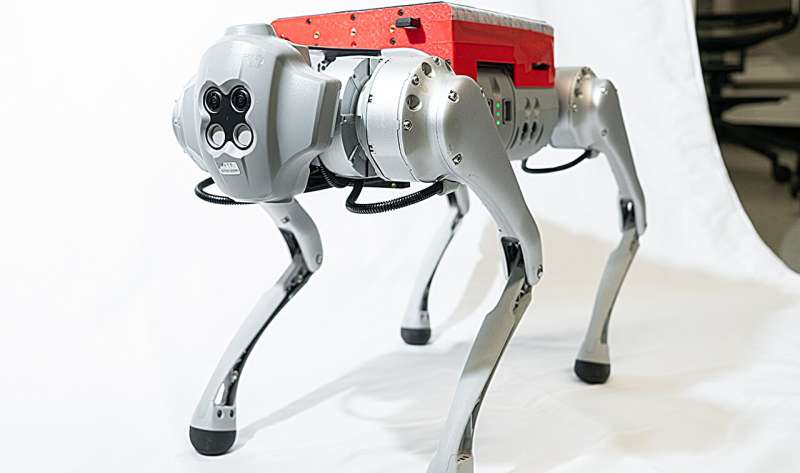
Researchers at Carnegie Mellon University have demonstrated a tactile-sensing system that allows four-legged robots to carry loose, unsecured objects eliminating the need for boxes, cradles or clamps and pushing quadrupedal platforms closer to real-world utility. The breakthrough centers on a high-density, back-mounted tactile array that lets the robot feel how a load shifts and self-correct in real time.
The problem is simple to describe but notoriously hard for robots to execute: carrying an object that isn’t fixed to the body demands continuous monitoring of both the object’s pose and the robot’s own motion. Humans rely on finely tuned neuromuscular feedback to balance trays or stacks of boxes, but robots must infer every nudge, slip and tilt numerically something today’s platforms struggle with.
The CMU team’s solution, called LocoTouch, blankets the robot’s back with a distributed tactile sensor array built from a piezoresistive film sandwiched between conductive-fabric electrodes. More than 4,000 crosspoints act as sensing units. When an object presses or shifts, the film deforms, changing resistance at specific intersections. Those micro-changes generate a detailed pressure map that tells the robot precisely how the load is moving.
To make sense of that torrent of data, the researchers used reinforcement learning training more than 4,000 digital twins of the robot to respond to every possible perturbation of a cylindrical load. The learned policy transferred to the real robot with zero fine-tuning, enabling it to navigate cones, step over obstacles, and withstand human interference while still keeping objects of varying shapes and sizes onboard for more than 60 meters.
The results mark the first deployment of full-surface tactile sensing on a quadruped and point toward richer human-robot interaction. The team now plans to scale the sensor array to cover entire robots, enabling them to brace against walls, manipulate irregular objects, and operate more safely around people.
Potential applications stretch from home-assistant robots and hospital logistics to manufacturing floors and outdoor monitoring such as carrying sensor payloads into unstable terrain for landslide detection. And one day, the researchers say, the same technology might even help keep cargo stable in the back of a moving truck.


