
One change in chip architecture is helping reduce parts, board space, and design effort—all at the same time.
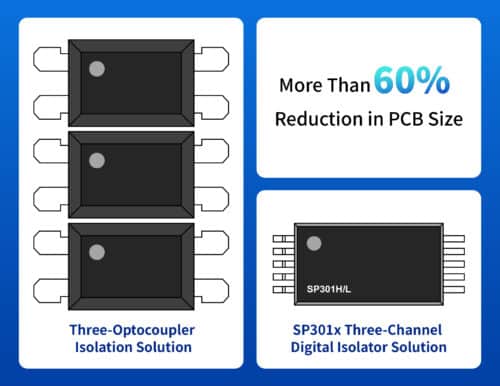
NOVOSENSE has introduced the SP301H/L series of three-channel digital isolators for RS485 communication isolation, combining three isolation channels into a single chip to reduce component count, simplify PCB design, and improve communication reliability. Built on the company’s third-generation capacitive isolation technology, the series supports data rates of up to 8 Mbps while lowering power consumption and reducing PCB area compared to previous generations.
Unlike conventional RS485 isolation designs that require three separate optocouplers, the series of isolators integrates all three channels into one device. Packaged in a compact SSOW10 wide-body package, it reduces PCB space by more than 60%, simplifies routing, and lowers overall system cost.
The devices support data transmission speeds of up to 8 Mbps, while the enable control channel operates at up to 1 Mbps. The SP301H features a default-high enable pin, and the SP301L offers a default-low enable pin, allowing designers to match different MCU enable logic requirements. Low quiescent current also makes the series suitable for battery-powered equipment and field instruments. The devices operate across an industrial temperature range of –40°C to +125°C.
The SP301H/L series is designed to maintain stable communication in electrically noisy environments. Compared with the earlier SP301A and NIRS31 series, it provides about 10% higher electrical overstress (EOS) tolerance and latch-up immunity above 10 V. It also delivers a typical common-mode transient immunity (CMTI) of 200 kV/μs, helping reduce communication errors caused by transient noise and high-frequency power supply disturbances.
For safety-critical systems, the devices provide isolation with withstand voltage of up to 5 kVrms for one minute and surge protection above 10 kV, meeting reinforced insulation requirements for industrial applications.
The series is intended for use in electric vehicles, solar power systems, energy storage systems, EV charging infrastructure, industrial automation equipment, and AI server power supplies, where reliable electrical isolation is required for safe system operation.
Click here for the original announcement.