The spectrometer measures light from ultraviolet to near-infrared using low voltage. It fits on a chip and enables new tools for imaging and analysis.
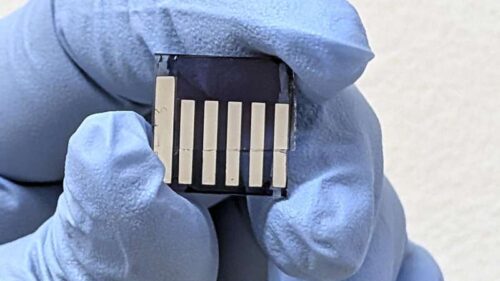
Researchers at North Carolina State University have built a spectrometer much smaller than existing ones, yet capable of measuring light wavelengths from ultraviolet to near-infrared. This could lead to handheld spectroscopy tools and new imaging devices using arrays of these compact sensors.
The prototype spectrometer is only a few square millimeters in size—small enough to fit on a phone, and potentially as small as a single pixel. It operates quickly, at low voltage, and is sensitive to a broad spectrum of light.
By rapidly applying a range of low voltages to a photodetector and measuring the light captured at each voltage level, it’s possible to collect enough data for a simple computational program to accurately reconstruct the light’s spectral signature. This process uses less than one volt and takes under a millisecond to complete.
The technology uses a miniature photodetector that can sense different wavelengths of light after the light interacts with a target material. By applying different voltages to the photodetector, the sensitivity can be adjusted to detect specific wavelengths.
Earlier efforts to shrink photodetectors often relied on bulky optics, required high voltages, or lacked sensitivity across a broad wavelength range. In contrast, the new pixel-sized spectrometer demonstrated accuracy comparable to conventional spectrometers and sensitivity similar to commercial photodetection devices.
Spectrometers are essential for understanding the chemical and physical properties of materials by analyzing how light changes when it interacts with them. They are used in a wide range of applications, from manufacturing to biomedical diagnostics. However, even the smallest spectrometers available today are still relatively bulky.
The compact size and low energy demand of the technology make it suitable for use in consumer devices, such as smartphones. It also opens up new possibilities for accessible imaging spectroscopy, microscopic analysis, and other research applications.