Can interfaces become both transparent and responsive? This technology can blend transparency, touch and force sensing into a single layer.
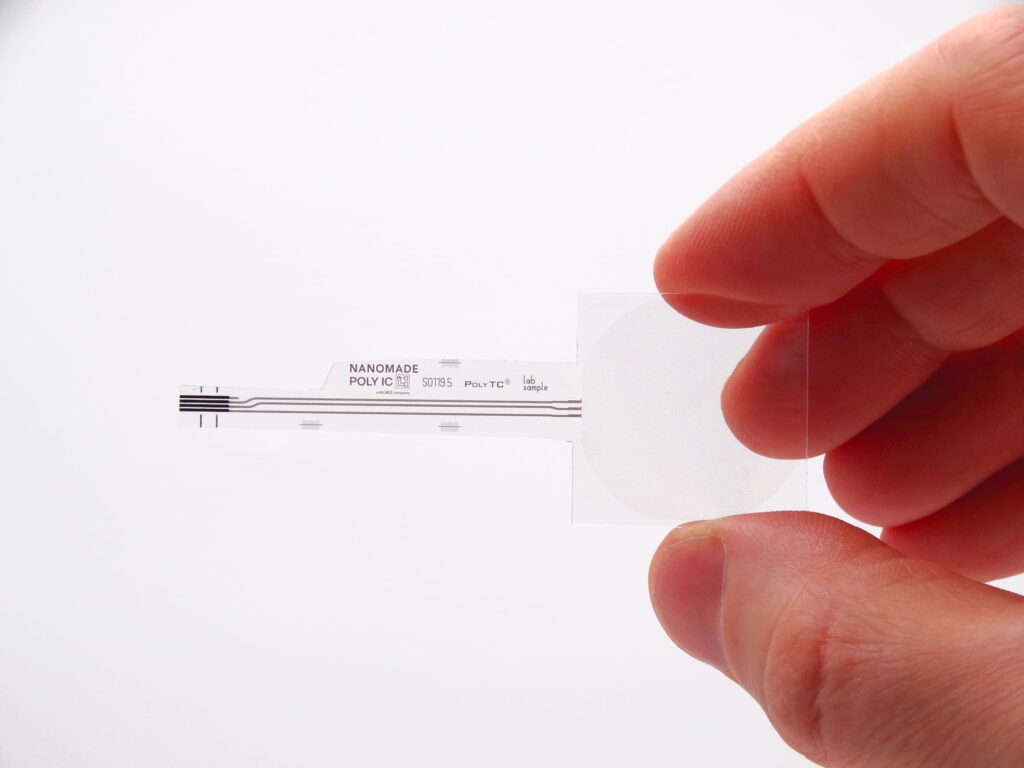
Nanomade, in collaboration with PolyIC, has unveiled the world’s first fully transparent film that combines capacitive touch with ultra-sensitive force sensing, enabling designers to create flexible, edge-to-edge, and curved human-machine interfaces without compromising optical clarity or performance. This breakthrough allows more reliable user interaction, supporting use with gloves, in humid or wet environments, and reducing unintended activations, while offering precise differentiation between light contacts and deliberate presses.
The technology can deliver clear advantages for manufacturers and system designers. By integrating touch and force sensing in a single ultra-thin layer, it eliminates the need for complex assemblies, simplifying production and reducing costs. The solution allows the creation of “hidden-until-lit” controls, fully transparent backlit surfaces, and premium minimalist interfaces that were previously difficult to achieve. Its force-sensing capability enables gradual haptic feedback, improving safety and user experience, particularly in industrial, automotive, and medical applications.
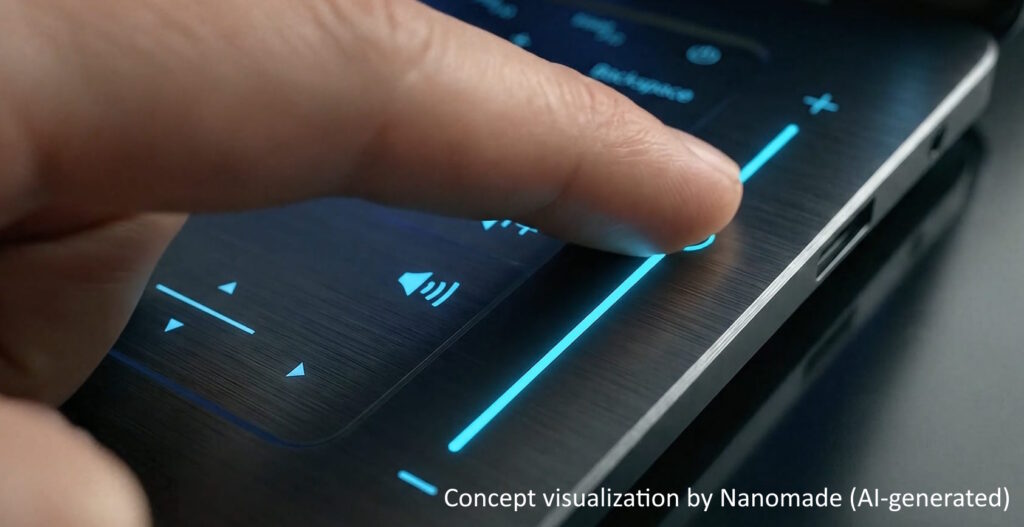
At the core of this innovation is a printed-electronics approach. PolyIC produces a transparent capacitive film with printed electrodes, while Nanomade’s proprietary nanoparticle-based ink adds ultra-sensitive force detection directly on the same substrate. The flexible stack can be laminated under existing displays or panels without redesign, maintaining optical clarity and light transmission even in curved or 3D-shaped interfaces. The technology supports applications across consumer electronics, automotive interiors, smart home devices, and medical equipment, where intuitive, glove-friendly, and hygienic operation is critical.
This first-of-its-kind touch film can represent a major milestone in human-machine interface technology, where design freedom, illumination, and intelligent sensing converge to redefine the user experience.