




Researchers from Japan have developed tuneable blue semiconductor lasers initiating practical far-UV light sources.
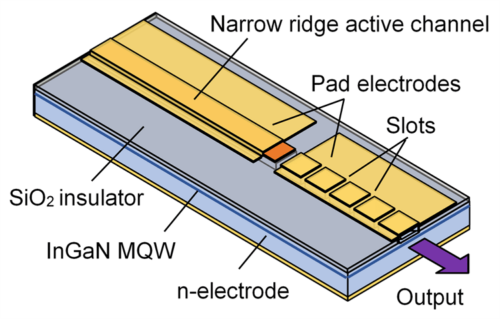
Scientists at Osaka University, Japan have introduced a compact, tunable-wavelength blue semiconductor laser, marking a transformative step in far-ultraviolet (UV) light technology. The research highlights the potential of this innovation for sterilisation and disinfection in public and private spaces.
This laser operates using a periodically slotted structure within nitride semiconductors, paving the way for adaptable blue-wavelength lasers suited for next-generation disinfection technologies. Contrasting with traditional systems that rely on large, costly ultrashort-pulse lasers, this compact design offers a practical solution, requiring a wavelength of approximately 460nm for efficient far-UV generation.
Previous advancements by the Osaka team included second-harmonic generation devices capable of producing wavelengths below 230nm. These utilised transverse quasi-phase-matching technology with aluminium nitride and SrB4O7 nonlinear crystals in microcavity designs. However, such systems were impractical for widespread use due to their size and cost.
The newly developed laser addresses these limitations. It operates in the 405nm band, with a structure that can be modified for 460nm applications. This tunability makes it compatible with high-efficiency wavelength conversion devices, which demand single-wavelength lasers for optimal performance. Prior single-mode blue lasers offered limited wavelength control; a challenge now overcome with this innovation.
“Our tuneable-wavelength nitride semiconductor laser enables a compact, safe far-ultraviolet light source, ideal for continuous indoor use in sterilisation and disinfection,” explained Taisei Kusui, lead author, Osaka University.
Beyond its efficiency, the laser’s compactness and longevity make it an attractive option for integration into everyday appliances like refrigerators and air conditioners. Such applications promise to enhance public health by maintaining cleaner, safer indoor environments.
This innovation underscores the growing role of advanced semiconductor lasers in addressing global challenges, providing a scalable solution for sterilisation needs across industries and households alike.


