

Designed for next-generation sustainable electronics, the new artificial synapse combines femtojoule-level power consumption with long-lasting memory and full biodegradability, pointing to eco-friendly neuromorphic devices that leave no electronic waste behind.
A team of researchers at Ulsan National Institute of Science and Technology (UNIST) has developed an ultra-low-power, fully biodegradable artificial synapse that combines long-lasting memory with minimal environmental impact, a meaningful advance for sustainable neuromorphic electronics.
The device mimics how biological synapses store and process information while addressing two major limitations of conventional artificial synapses: high energy consumption and electronic waste. At the top level, the artificial synapse delivers record-breaking memory retention for a biodegradable device, maintaining information for approximately 6,000 seconds (about 100 minutes) significantly longer than prior biodegradable counterparts. It does so while operating at ultra-low energy, using just 0.85 femtojoules per signal, which is lower than the energy typically required by biological synapses.
The device’s architecture centers on a multilayer “sandwich” of natural, eco-friendly materials derived from shells, beans, and plant fibers. Cellulose acetate from plant stems forms a key ion-binding layer, while other biodegradable polymers serve as ion-active layers. When a tiny electric stimulus is applied, sodium ions acting like neurotransmitters migrate and bind at interfaces, a mechanism that enables stable retention of electrical states even after stimulation stops.
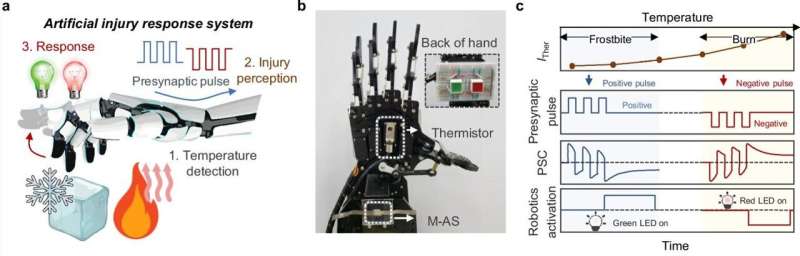
A critical trait of this synapse is its completely biodegradable nature: all layers break down naturally in soil within about 16 days, leaving no harmful residues. This compares with typical electronics that persist in landfills for decades and contributes to growing e-waste challenges worldwide. The researchers also demonstrated a simple robotic reflex system using this synapse, where heat detection triggers a robotic hand to withdraw a proof-of-concept showing how biodegradable neuromorphic components could one day be woven into eco-friendly robotics and sensors that vanish after use.
While further work is needed to scale stability and integration into complex systems, this work represents a significant step toward sustainable, biodegradable computing elements that could reduce environmental impact and energy demand in next-generation electronics.