New surface-mount hybrid polymer capacitors are engineered to survive extreme vibration while delivering low ESR and stable performance in compact power-dense designs.
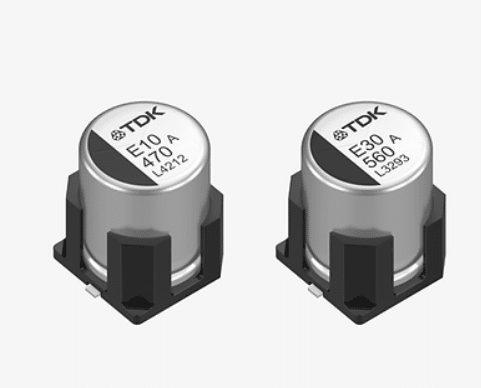
A new range of surface-mount hybrid polymer aluminum electrolytic capacitors by TDK Corporation has entered the market, aimed squarely at automotive and industrial electronics operating in high-vibration environments. The components are designed to withstand mechanical stress levels that typically challenge conventional electrolytic solutions, making them suitable for next-generation vehicles, factory automation equipment and heavy-duty power electronics.
The key features are:
- Vibration resistance up to 30 g
- Hybrid polymer construction with low ESR
- Wide voltage and capacitance range
- High ripple current capability
- Automotive- and industrial-grade temperature ratings
At the core of the update is enhanced mechanical robustness. The capacitors are qualified to handle vibration levels up to 30 g, enabling reliable operation in applications exposed to continuous movement, shock or oscillation. This includes automotive subsystems such as power steering, braking, pumps and DC-DC converters, as well as industrial platforms like robots, drives, power tools and embedded compute hardware. The improvement targets a common weak point in compact electronics, where vibration can degrade solder joints or internal connections over time.
The devices use hybrid polymer technology, combining the benefits of polymer and liquid electrolytes. This approach delivers low equivalent series resistance (ESR) and strong ripple current handling, both of which are critical for stable power delivery in modern high-current, fast-switching circuits. The result is improved efficiency and reduced heat generation compared with traditional aluminum electrolytic capacitors.
Despite the added mechanical strength, the components retain a compact surface-mount footprint. Voltage ratings span typical automotive and industrial rails, while capacitance values cover a broad range suited for smoothing, buffering and decoupling tasks. The parts are compatible with standard reflow soldering processes, supporting high-volume automated assembly.Thermal endurance is another key focus. Depending on the variant, operating temperature ranges extend from deep sub-zero conditions up to high ambient temperatures, aligning with under-the-hood automotive requirements and industrial enclosures. Long operational life ratings at elevated temperatures further support use in systems expected to run continuously for years.
As vehicles electrify and industrial systems become more compact and power-dense, passive components are increasingly pushed to their limits. By addressing vibration, temperature and electrical performance together, these new capacitors aim to improve long-term reliability where mechanical stress is unavoidable.