A wearable sensor detects vibrations from breathing, speaking, swallowing, and coughing. It works without external power and can help monitor body signals in health devices.
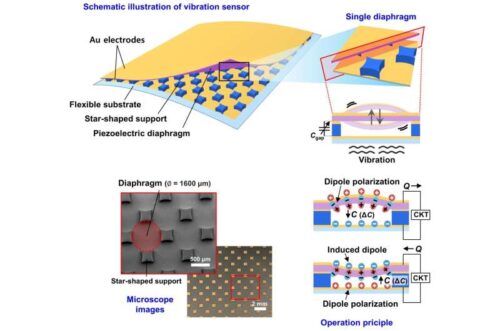
A research team from Pohang University of Science and Technology has built a wearable vibration sensor that detects very small signals from the human body without using an external power source. The device captures subtle vibrations produced during breathing, speaking, swallowing, and coughing. The technology could support new types of wearable health-monitoring devices.
The human body constantly produces small vibrations. Many are too weak to notice but still contain information about breathing, speaking, swallowing, and other body activities. Detecting these signals is difficult because body sounds occur across many frequencies. Breathing, swallowing, and speech appear at lower frequencies, while coughing or groaning occurs at higher ones. Sensors must detect very small vibrations while working across this wide range. However, many existing wearable vibration sensors struggle with this. Their sensitivity can vary across frequencies, many require external power, and their performance can drop when exposed to skin contact or sweat, limiting their use in wearable devices.
To solve this, the researchers combined two sensing approaches in one device. The sensor integrates a piezoelectric material that produces electrical charge when mechanical stress is applied with a capacitive sensor that detects motion through changes in the distance between electrodes. Electricity generated by the piezoelectric component powers the capacitive sensor, allowing the system to operate without an external power source while maintaining consistent sensitivity across frequencies.
The team also redesigned the internal structure of the sensor. Beneath the vibration diaphragm, star-shaped micro-supports hold a circular diaphragm at the center. The spaces between the supports allow air to flow freely. This prevents trapped air from interfering with diaphragm movement and makes it possible to place sensors closely together without reducing performance.
Tests showed that the device detects vibrations from 80 to 5,000 Hz and senses motion as small as 0.01 g. When attached to the neck, it recorded small vibrations from the vocal cords and captured signals from speech, breathing, and coughing. When placed on sound-producing objects, it also measured surface vibrations and functioned like a contact microphone.
These results suggest that the sensor can detect faint vibrations that many existing wearable technologies miss, opening the possibility for more precise monitoring of body signals in wearable devices.