The capacitor can combine high capacitance, voltage tolerance, and improved reliability while reducing board space requirements in automotive environments. How?
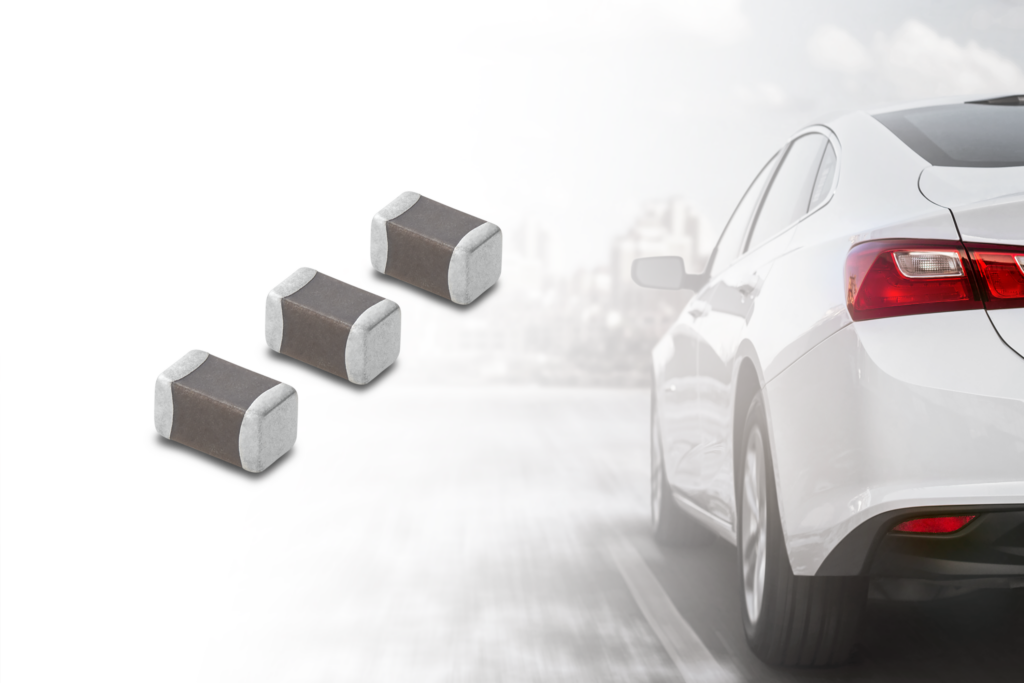
Murata Manufacturing has introduced the GCJ21BD72A225KE02, a soft-termination multilayer ceramic capacitor (MLCC) designed for automotive powertrain, safety, and advanced electronic systems. The component is claimed to be the first soft-termination chip MLCC to deliver 2.2μF capacitance at 100Vdc in the compact 0805-inch (2.0 × 1.25 mm) package.
The launch addresses growing demands in modern vehicles, where electrification, advanced driver assistance systems (ADAS), autonomous driving technologies, and 48V power architectures require higher performance components within increasingly constrained board space.
The capacitor achieves specifications that were previously available only in larger 1206-inch packages. According to the company, this enables approximately 51 per cent reduction in mounting area compared with its earlier 2.2μF/100Vdc offering, while delivering around 2.2 times higher capacitance than previous 0805-inch, 100Vdc products.
The device is based on proprietary ceramic material technologies, including advanced particle size and uniformity control, allowing greater capacitance density without increasing component size. Its soft-termination structure is designed to absorb mechanical stress caused by board flexure, vibration, and thermal cycling, helping reduce the risk of cracking after mounting.
These characteristics are particularly important in automotive environments, where electronic systems are exposed to continuous mechanical and thermal stresses throughout vehicle operation.
The GCJ21BD72A225KE02 supports an operating temperature range from -55°C to +125°C and complies with X7T temperature characteristics defined by EIA standards.
By combining high capacitance, high voltage capability, compact dimensions, and enhanced durability, the capacitor is aimed at supporting next generation automotive electronics where space efficiency and reliability are becoming increasingly critical design requirements.
The introduction expands the company’s automotive grade MLCC portfolio as vehicle manufacturers continue integrating more power management, sensing, and safety functions into compact electronic control systems.
Click here for the official announcement.