Currently, local area networks are used for a wide variety of purposes, their applications extend far beyond connectivity between computers. Specialized manufacturers, such as the Lanberg brand, therefore offer a wide range of solutions adapted to every application.
In this article, we present the range of Ethernet cables from the Lanberg brand Lanberg: their types and characteristics, primarily in the context of potential applications. These are products that have relatively recently entered the TME catalog, but are already available from our catalog and directly from warehouses, thanks to which we can guarantee customers express shipping.
Lanberg Ethernet Cable Offer
Ethernet cables, also known as LAN cabling, have a structure strictly defined by international standards – which does not mean that all products are equal. Important differentiating factors for solutions available on the market are the quality of materials used, compliance with safety standards, and adaptation to specific applications.
All presented cables have 8 cores. They can be in the form of solid wire or stranded wire. In the latter, each core consists of many very thin copper strands, which translates into improved flexibility and lower weight. Nevertheless, high transmission parameters (resulting from better conductivity) are achieved using cables with solid cores, which additionally show greater mechanical resistance, although they are intended for static installations. It should be noted here that for the most typical applications, e.g., connecting a computer to a router, practically all of the presented Lanberg products can be used. Differences begin to play a significant role only when seeking a product best suited for a given professional application and specific environmental conditions. We will focus on these aspects below.
Ethernet Categories
The construction and related capabilities of Ethernet cables are defined by their category. Generally, the higher the category, the greater the cable’s throughput and resistance to electromagnetic interference (EMI): external and internal (mutual between pairs). Categories are associated with parameters such as maximum signal frequency, link length, and the type of shielding for cables and individual pairs.

New Lanberg network cables in the TME offer belong to four Ethernet categories:
- Cat 5e – an improved version of Cat5, supporting speeds up to 1Gbps at a frequency of 100MHz. Cables of this category are used in home and office LAN networks. The maximum cable length reaches 100m. Most of these products do not have a shielding layer (or a metalized foil layer), and their insulation is made of polyvinyl or polyethylene.
- Cables Cat 6 support speeds up to 1Gbps over a distance of up to 100 meters and 10Gbps between points at shorter distances (up to approx. 50m). They operate at a frequency of up to 250MHz. They are well-suited for modern offices and more demanding network environments.
- Cat 6a is an improved version of Cat6 (‘a’ from augmented), offering 10Gbps speed over a full distance of 100 meters at a frequency of up to 500MHz. It features better shielding, which increases resistance to interference and signal attenuation. Cat6a cables are ideal for advanced corporate networks, data centers, and multimedia applications.
- Cables Cat7 are used almost exclusively in professional and very demanding applications (server rooms, internal data center connections, etc.). Offering speeds up to 10Gbps at a frequency of 600MHz over distances up to 100m. They are characterized by full shielding of each pair of wires and a braid surrounding all cores. This provides excellent EMI protection. As can be seen, the choice of cable category will primarily be dictated by the requirements of a given application.
Cable Construction
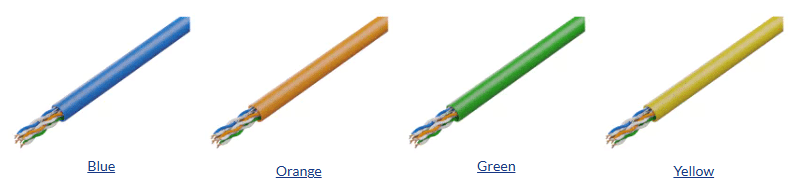
Lanberg cables are available in many types, in blue, orange, green, yellow and other colors, not listed in the table below: black, gray, and red. The variety of colors will help technicians quickly identify individual lines in larger bundles. However, it should be emphasized that not all cable types allow for color selection.
In terms of construction, the supplier offers F/UTP types (single shielding using metalized foil), SF/UTP (double shielding using foil and braid), S/FTP (protection of individual pairs and the entire bundle), U/FTP (shielding only of pairs), U/UTP (no shielding).
In most Lanberg products, PVC and PE are used for insulation, however, in selected solutions, LSZH material is used, meaning low smoke, zero halogen, which in case of contact with flame produces small amounts of non-toxic smoke. This is directly related to regulations governing the use of cabling in specific buildings.
CPR Standards
The CPR (Construction Products Regulation) directive is an EU construction regulation that governs requirements regarding the properties of, among other things, cables permanently installed in buildings. These standards aim to increase fire safety (spread of fire and smoke emission). According to CPR classification, Lanberg Ethernet cabling belongs to groups: Dca, Eca and Fca. According to European Union law, this means that:
- Fca do not meet the requirements specified by Eca;
- can be used in single-family residential buildings, detached houses, outbuildings, employee buildings (e.g., workshops), service buildings, commercial buildings, warehouses (classification Eca);
- products Dca can be installed in multi-family and multi-story homes, as well as public utility buildings (schools, hospitals, etc.).
It is worth noting that the characteristics described above relate solely to building regulations, and not to mechanical durability or communication parameters. The legislator here primarily considered the chemical composition of cable insulation and how their combustion would affect human health and the spread of fire.
Overview of Applications
The wide selection of Lanberg cables ensures that the manufacturer’s offer covers most typical applications. The supplier’s products allow for the implementation of home and local LAN networks, private office cabling (connection to cloud and corporate VPN, transmission of high-quality multimedia materials). They will also prove successful in applications such as network gaming (multiplayer, local servers) or installations in small and medium-sized enterprises (SMEs). Lanberg products can also be used for the implementation of IPTV monitoring systems.