The demand for efficient and versatile solutions for implementing intuitive human-machine interfaces (HMI) is constantly growing. Meanwhile, the company Riverdi, a leader in its industry, has recently introduced new solutions in this area: 15-inch intelligent EVE5 displays.
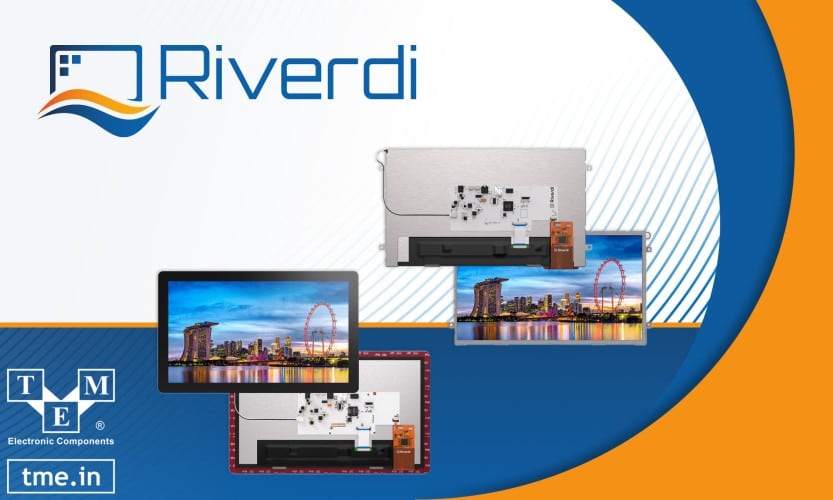
Riverdi 15.6-inch displays with Full HD resolution provide unparalleled capabilities in building interfaces and related applications. They enable, among other things, real-time image integration, supporting input from industrial cameras, advanced medical systems, or monitoring installations. Below we describe this new generation of displays, their capabilities, and an overview of key parameters.
Intelligent displays
The “intelligence” of the displays means their integration with a control system capable not only of controlling the image itself but also of executing more advanced programs, often handling the entire interface. In the case of the presented Riverdi displays, the heart of the circuit is the BT820B (EVE5) fifth-generation controller. The displays were developed in cooperation with Bridgetek, the manufacturer of the Embedded Video Engine, which allows them to combine the ability to display images in Full HD resolution (1920×1080), numerous multimedia functions (audio support via I2S), with a flexible and accessible object-oriented programming model.
To ensure smooth interface operation, DDR3 memory is used in the circuit (with a dedicated buffer allocated). Direct access to Flash memory, DDR3, and SD minimizes dependence on the main microcontroller (which controls the entire device in which the display will be installed). This significantly simplifies design and reduces the number of required components. The new EVE5 display series uses the ASTC image compression algorithm, which reduces the amount of data transmitted between memory and the graphics controller. Thanks to this, it is possible to use smaller graphic files without degrading image quality. Not only designers but also programmers will find their work easier: the displays use EVE tools provided by Bridgetek: EVE Screen Designer, EVE Screen Editor, and EVE Asset Builder. These environments are easy to master and include extensive documentation.
The high parameters of Riverdi EVE5 displays make them suitable for many demanding fields, such as:
- Medicine – direct real-time image display from endoscopes, ultrasound devices, etc.
- Industry – vision systems and process monitoring.
- Commerce – intuitive and attractive multimedia interface in one device, ideal for interactive kiosks, ticket machines, point of sale terminals, and self-service (POS).
- Transport – good readability even in direct sunlight allows the displays to be used in passenger information systems, fleet management panels, route visualization, etc.

Similarities
Most parameters are identical for all Riverdi displays. Above all, they all have 15.6-inch TFT LCD matrices with a resolution of 1920×1080 pixels. These are IPS displays, offering a wide viewing angle, excellent visibility, and contrast (1000:1) from every angle. LEDs are used for backlighting. The image is presented using a 24-bit palette (16.7 million colors).
Regardless of the model, the displays require a power supply voltage in the range of 6…17V DC and feature a 20-pin connector with a 0.5mm pitch. Additionally, the controller board includes an SD card slot and speaker outputs.
Differences
The primary difference between available models is the touch matrix (capacitive), which is present in most versions, though not all. Where installed, it is manufactured using optical bonding, meaning the space between the display and the touch panel is filled, which results in excellent readability and reduced reflections. There are two types of EVE5 touch displays: aTouch and uxTouch. In the first case, the touch panel along with the matrix is housed in a metal frame, which has mounting holes and requires enclosure. In the uxTouch version, the module is covered by a front glass masking all mechanical elements. It has a black bezel around the active area with rounded corners.
Additionally, it is worth noting that the non-touch interface versions have slightly higher brightness: 1000 cd/m2 compared to 850 cd/m2.