

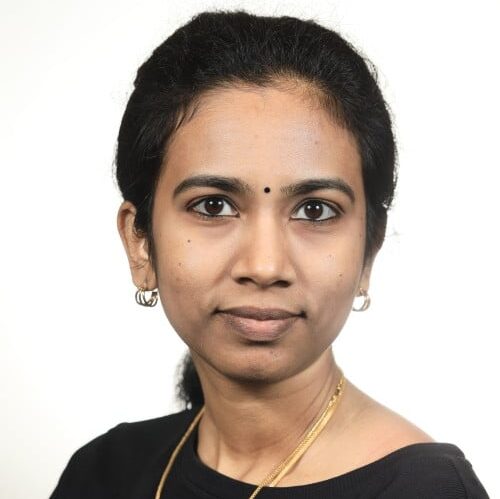
In EFY’s Women Power Series, Dr K. Mithra, an independent wireless researcher and inventor based in Scottsdale, speaks to Akanksha Sondhi Gaur. A PhD from Anna University, she leads innovations in antenna engineering, 5G/6G, and AI-driven network security, with research and patented breakthroughs across IEEE, Elsevier, and Springer.
Q. What inspired you to start your journey, and what was the defining moment that made you leap?
A. My inspiration began as a simple childhood dream, just two letters: ‘Dr in front of my name. That was all. From an early age, I was captivated by how technology works, how invisible signals travel through the air, how antennas communicate across vast distances. Yet beyond thisfascination, there was a deeper drive: I wanted to prove to myself that I could reach the highest level. When I completed my Master’s degree, pursuing a doctorate felt like the natural next step. Not because it was expected of me, but because I had made a promise to myself, which became my turning point. Everything that followed was simply about finding the courage to honour it.
Q. What were the biggest challenges you faced as a woman, and how did you overcome them?
A. The greatest challenge I faced was not in a laboratory or a classroom. It was in the drawing rooms, across dinner tables, and within casual conversations with well-meaning people who genuinely could not understand why a girl would want to study ‘so much.’ When I shared that I wanted to pursue a PhD after my Master’s degree, the questions came: Why does a girl need a doctorate? Who will marry you if you are more educated than your prospective husband? Areyou not making your life unnecessarily difficult? These words were not spoken with malice, and that is what made them harder to bear. They came from concern, from people who believed they were protecting me from a complicated future. I answered those doubts in the only way I knew how: by continuing. Every semester I completed was an answer. Every paper I published was an answer. And the day I defended my dissertation and earned the title ‘Dr K. Mithra’, that was my final answer to every question.
Q. Did you face bias from others or self-doubt because of your gender?
A. Yes to both, and I will be honest about that. The external bias was subtle but constant, the quiet assumption that I was less serious, that my research career would eventually be set aside for family, that I needed to be reminded of my ‘priorities.’ I learned to let it sharpen me rather than diminish me. The self-doubt was harder to deal with because it was internal. There were moments during my doctoral years when I wondered if everyone else was right. If I were being unrealistic. Suppose I were making things unnecessarily complicated for myself. What pulled me through was passion, a genuine, stubborn love for my field that was stronger than the doubt. When you truly love what you do, you find reasons to continue even when the world gives you reasons to stop.
Q. Can you share a failure or setback that became a turning point in your growth?
A. One of the hardest seasons of my professional life was returning to work after maternity leave. I had taken time away as any mother must, and when I was ready to return, I encountered something many women know, but few speak about openly: the career gap stigma. The questions, the hesitation, the sense that somehow the time I had spent growing and nurturing a human being had made me less credible as a scientist. It shook my confidence in ways that my toughest research problems never had. But again, I decided I would not quietly shrink back into the profession. I would return with more publications, more contributions, more visibility. And I did. That period transformed me from someone who wanted to be a good researcher into someone who also wanted to be a voice for the women who are still stuck in that gap, afraid to come back.
Q. How did your family or support system influence your journey, and how did you balance personal and professional responsibilities?
A. My parents believed in me when society did not. They never once asked me to choose between my ambitions and their expectations; they simply expected me to aim high. That foundation gave me the confidence to take risks. When I married, I was fortunate again. My husband and my in-laws understood that my career was not a hobby or a phase; it was who I am. They created space for me to thrive, which made all the difference.I will not pretend balance is easy. It is not. Some days, the scales tip heavily in one direction. I have learned that balance is not about equal time, but about full presence in the role you are in. When I am a researcher, I am fully that. When I am a mother and wife, I am fully that. Intentional compartmentalising, not guilt, has kept me sane.
Q. What keeps you motivated during tough times, and what belief has guided you throughout your journey?
A. Curiosity keeps me going. Genuine, childlike curiosity about how things work and what we do not yet understand. When the professional world feels frustrating or unfair, I go back to the work itself, to the equations, the experiments, the questions still waiting to be answered, and that restores me every time.
The belief that has guided me is simple: the work will speak for itself if you do not stop doing it. Citations do not ask about your gender. Patents do not know your background. A well-designed antenna array does not care who designed it. So I focused on building a body of work that could stand on its own, and gradually, it did.
Q. Have you introduced any changes in your organisation as a woman leader, such as inclusive policies, mentorship, or cultural shifts?
A. During my time as an Assistant Professor, I was deliberate about mentoring women students in my department, particularly those who showed technical aptitude but lacked confidence. I saw myself in many of them. The hesitation before asking a question in class, the tendency to undervalue their own ideas, and the way they would wait to be invited rather than simply stepping forward.
I tried to be the person I had needed. I told them directly: your ideas belong in this room. Say them out loud. Small interventions, perhaps. But the women who remember those moments tell me they mattered.
Q. What common mistakes should aspiring women leaders avoid, and what would you do differently if starting today?
A. The biggest mistake I see, and one I made myself, is waiting for permission. Waiting until you feel fully ready or confident is a mistake. That moment rarely arrives on its own. Confidence is built by doing, not by waiting. Do not carry the weight of other people’s timelines. Society may tell you when to settle, slow down, or step back. It is not your schedule. Write your own. If I were starting today, I would build my professional presence, publications, visibility, and networks, earlier and more intentionally. Not for ego, but because visibility creates opportunity, and opportunity creates impact.
Q. How is the ecosystem evolving for women leaders, and what message would you give to the next generation?
A. It is evolving genuinely. More slowly than it should, but it is moving. I see more women in technical leadership roles, more conversations about structural barriers, and more institutions taking mentorship seriously. That is real progress. But the progress is uneven. In many parts of the world, including the communities I grew up in, the drawing-room conversations have not changed much. The questions about ‘too much education’ are still being asked. So my message to the next generation is this: you do not have to wait for the ecosystem to be perfect before you begin. Begin anyway. The women who went before you began in far harder conditions. You owe it to the women who will come after you to keep moving forward, so that the path they inherit is a little smoother than the one you walked.
Q. What are three things that society can do to make it easier for future women leaders to rise?
A. First, respect the career gap. Maternity leave, caregiving breaks, and family obligations are not signs of weakness or lack of commitment. They are signs of a whole life lived. Industries must stop penalising women for being human. Return-to-work programmes, mentoring for women re-entering the profession, and simply dropping the interrogation of career gaps in hiring would change thousands of women’s trajectories. Second, educate boys and men alongside girls and women. Inclusion is not just a women’s project. The families, workplaces, and societies that hold women back are largely shaped by attitudes formed in childhood. If we raise the next generation of boys to see women’s ambitions as natural and worthy of support, the way my husband and in-laws did, we will not need to have this conversation in twenty years. Third, normalise ambition in women. Not just tolerate it, normalise it. Embrace it. The moment a girl says she wants to be a doctor, a scientist, a leader, the response should be, ‘Of course, you can,’ not followed by a list of reasons why it will complicate her life. That one shift in response, multiplied across millions of families, would be the most powerful change we could ever make.