

As edge AI chips surpass 900MHz, legacy hardware methods guarantee system failure. For designers, it’s adapt or go obsolete.
With the hype around artificial intelligence (AI) reaching a crescendo, you might have noticed a curious silence on social media. Unlike software, there is no loud noise or marketing campaigns peddling courses like “If you don’t learn this, you will become obsolete” for embedded systems.
Do not be fooled by the silence. Heed it as a warning before a massive industry disruption, the lull before the storm.
The first signs are already visible. Major semiconductor vendors are aggressively promoting AI-ready processors for edge processing. While many assumed that high memory prices would delay embedded AI/ML adoption, vendors have bypassed this hurdle. They are launching edge processors that operate at 900MHz and above.
For the average hardware engineer, this changes everything. Operating at frequencies above 300MHz pushes digital design straight into the analogue domain. Unfortunately, our education system remains stuck teaching obsolete 5V TTL logic, completely ignoring high-speed design, printed circuit board (PCB) layouts for high-speed circuits, and on-board DC-DC converters built for sub-1V (as low as 0.7V) requirements.
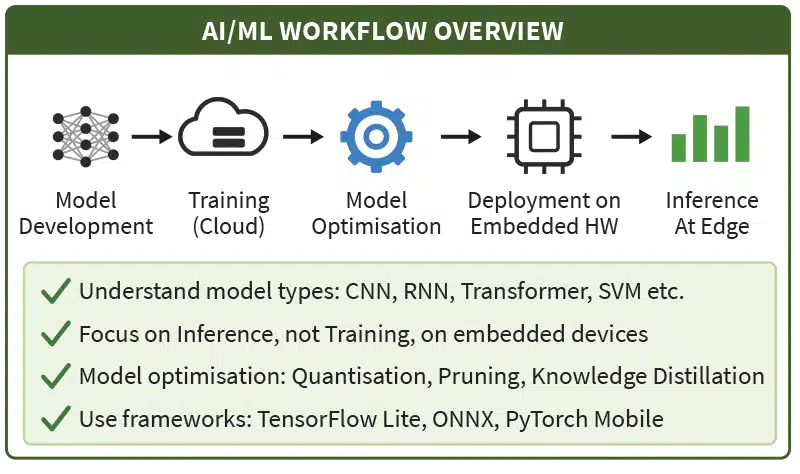
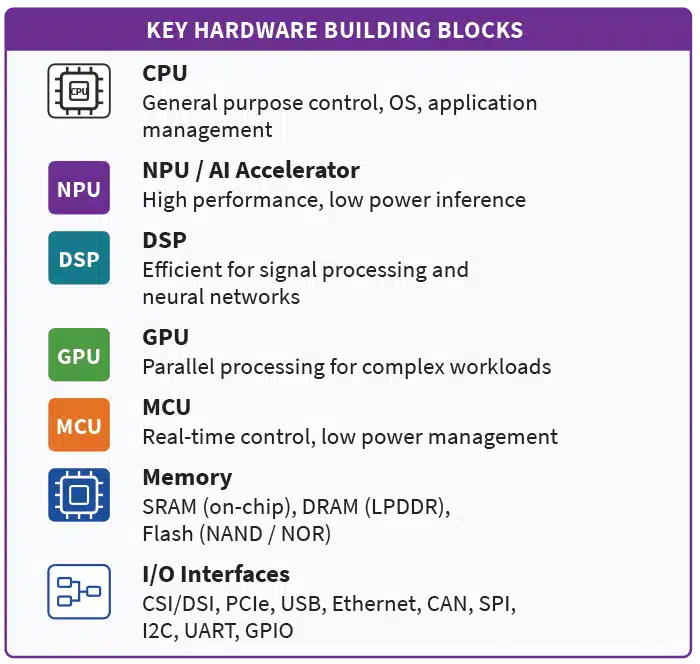
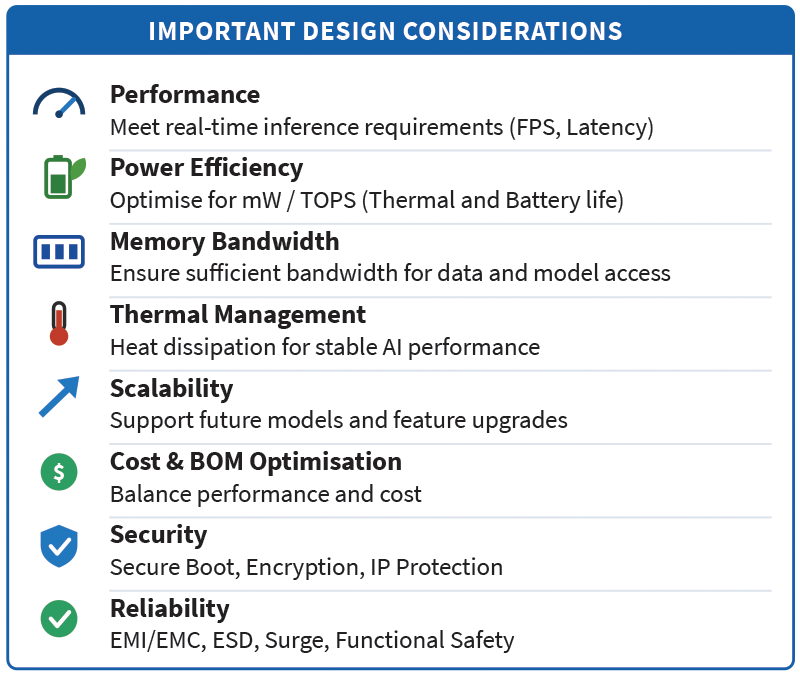

To survive and thrive in the AI/ML era, current-generation hardware designers must master the following baseline disciplines:
Holistic system understanding
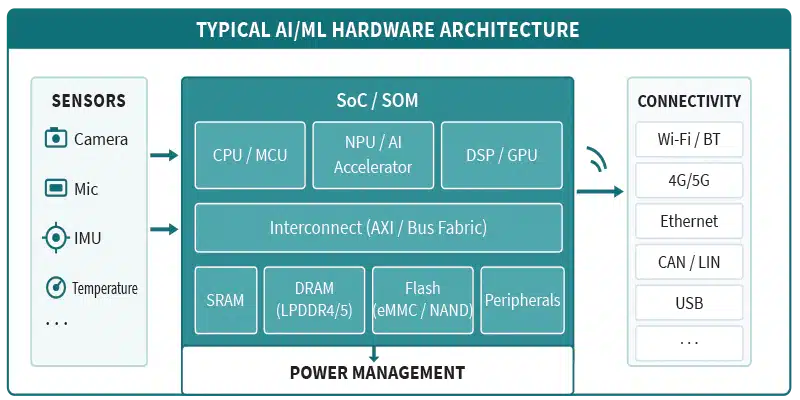
Without understanding the overall system architecture and data flow, designing hardware using high-speed AI/ML processors is impossible.
Solid foundations in high-speed design
Many designers mistakenly assume high-speed design is just a minor signal integrity issue. It is not. True high-speed design requires deep domain knowledge across multiple physical layers. Thanks to open source tools like KiCAD, teaching and learning high-speed design is no longer a resource bottleneck. Designers must master:
PCB material selection
Choosing the right substrates to handle gigahertz frequencies.
High-speed signal routing
Managing trace width, thickness, and routing paths to match electrical impedance, ensuring gigahertz signals flow smoothly without bouncing back or corrupting data.
Power distribution networks
Designing stable on-board DC-DC power supply units for low-voltage cores.
Thermal design
Mitigating severe heat dissipation from high-frequency chips.
EMC/EMI design
Engineering layouts to pass strict electromagnetic compatibility and interference standards.
Salient points
Embedded AI/ML systems are no longer isolated devices; they will always be connected. Hardware designers must understand both wired and wireless communication interfaces inside out. Crucially, you must know how integrating these interfaces impacts the surrounding hardware and overall system stability.
Once an edge device is deployed and connected, the ongoing cost of communication becomes a critical operational factor. This financial overhead cannot be an afterthought. It must be factored directly into the hardware design goals from day one.
Security has officially shifted from a theoretical, academic topic to a basic commercial necessity. AI edge devices are highly vulnerable targets, and designers must understand how to implement secure architectures at the hardware level to protect sensitive data and models.
The barrier between hardware and software has dissolved. Hardware engineers must know software now. You need a solid understanding of real-time operating systems and embedded Linux, specifically learning how to tune the operating system to maximise hardware performance.
Without a firm grasp of linear algebra and statistics, a hardware designer can never accurately size a controller or properly evaluate the mysterious neural processing unit (NPU).
The bottom line
This paradigm shift represents a major wake-up call, particularly for engineers who have overlooked the fundamental importance of mathematics and core electronics physics. While the transition to edge AI brings numerous complex challenges, mastering these seven areas forms the absolute baseline requirement for any hardware designer looking to stay relevant in the industry.
S.A. Srinivasa Moorthy is the chief of strategy at Zettaone Technologies Private Limited. He is a prominent technology evangelist and subject matter expert in electronic design and manufacturing, automotive electronics, and electric vehicles.