




What would it take for India to lead the global economy? The pieces are already on the table—young talent, digital rails, and entrepreneurial energy. What matters now is execution.
India must embrace One Nation, One Education so that opportunity is not defined by geography. Standardised quality, bilingual fluency, and a national Mission Maths must become non-negotiable.
Every generation faces a defining choice. For India, the choice is distinct: remain a large emerging economy, or step into its rightful place as the world’s foremost economic power by 2040. This is not only about pride or rankings. It is about survival, sovereignty, and responsibility.
Why #1 matters?
Historically, India has led in science and mathematics, contributing zero, the decimal system, astronomy, and surgery. Leadership is not new to India.
Civilisations have risen, peaked, and vanished: the Mayans, the Mongols, the Persians, the Romans. But India endures—looted, colonised, yet unbroken. Today, India has already climbed back into the world’s top three economies. History tells us that most fallen civilisations never return. Yet India has come back, again and again. That resilience is no coincidence.
Leadership now is not symbolic; it determines prosperity, sovereignty, and global influence.

Lessons from recent history
The dominant economies of the last century were built on strategic investments in technology, skills, and industrial capability. Their trajectories offer practical lessons for India’s next phase of growth.
The United States: Innovation as strategy
America’s rise after World War II was no accident—it was carefully engineered. The GI Bill of 1944 opened the doors of universities and vocational schools to millions of returning veterans, creating a workforce unmatched in skill and scale. Federal investments built highways, power grids, and airports, knitting the nation together and energising commerce. Cold War rivalries spurred massive funding into research, birthing a laboratory-to-market pipeline that later gave us Silicon Valley. By the 1960s, the United States was not just manufacturing goods—it was shaping global standards in science, technology, and culture.
Japan: Quality and discipline
From the ruins of 1945, Japan charted its comeback with quiet discipline and relentless focus on quality. Factories and classrooms alike embraced kaizen, the philosophy of continuous improvement. Policymakers steered resources into automobiles, electronics, and shipbuilding. Within two decades, ‘Made in Japan’ transformed from a symbol of cheap imitation to a global guarantee of excellence. Toyota, Sony, and Panasonic were no longer competing; they were dominating. Between 1960 and 1990, Japan’s GDP surged from tens of billions to several trillion dollars, propelling it to the world’s second-largest economy.
China: Scale and speed
No nation in modern history has rewritten its destiny as dramatically as China since the 1980s. Economic reforms created special zones, attracted global capital, and turned the country into the world’s manufacturing floor. Hundreds of millions were lifted out of poverty. High-speed railways, vast power plants, and entire cities were built at a breathtaking pace. Literacy soared, and national priorities shifted to artificial intelligence, semiconductors, and renewable energy. China’s story proves that when scale and speed are aligned with ambition, a single generation can transform a nation.
| From The Editor At Electronics For You, our mission has always been to make technology accessible, relevant, and actionable for every Indian. Technology has reshaped industries, created opportunities, and opened doors that once seemed closed. Much remains to be done for India to claim its place atop world economy. With this issue, we proudly introduce a landmark series: “India’s Path to #1 Economy,” authored by Janardhana Swamy. We invite you to read, reflect, and respond. India’s journey to becoming number one is a mission for all of us. Rahul Chopra Editor, ElectronicsForU.com Network |
Failures and warnings
Not all nations sustain their rise. Argentina, Brazil, and the Soviet Union show how corruption, policy instability, and weak market alignment can derail progress. Ambition without governance collapses, and education without innovation stagnates.
Why India is positioned to lead
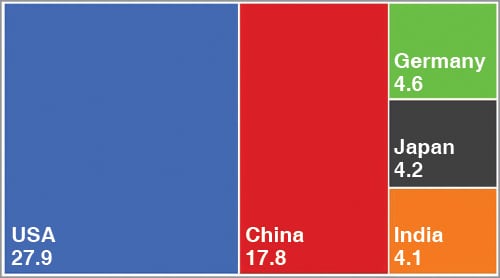
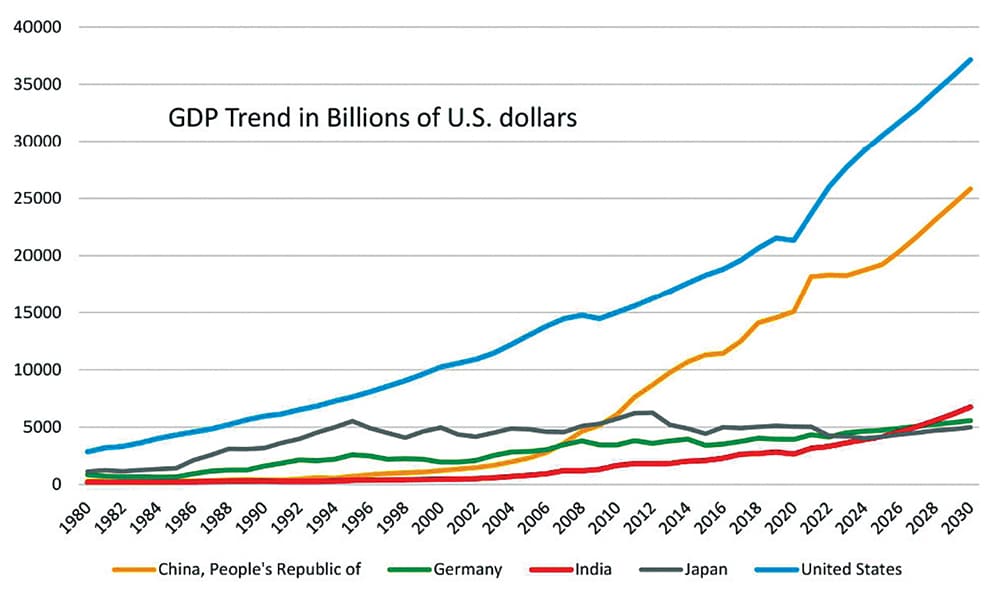
India is not at the margins. It is already in the race (Fig. 1). Today, it is among the five largest economies and is projected to surpass Japan and Germany in the near term.
Demographics
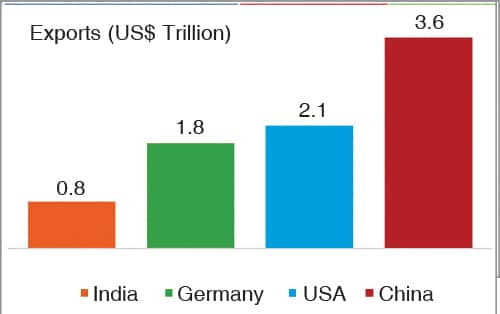
By 2040, India will have the world’s largest working-age population, while many competitors age. Presently, India has a large pool of young population, which it must enable (See Table 1). We must produce what the world wants to buy from us. There is a huge opportunity (See Fig. 3).
Digital public infrastructure
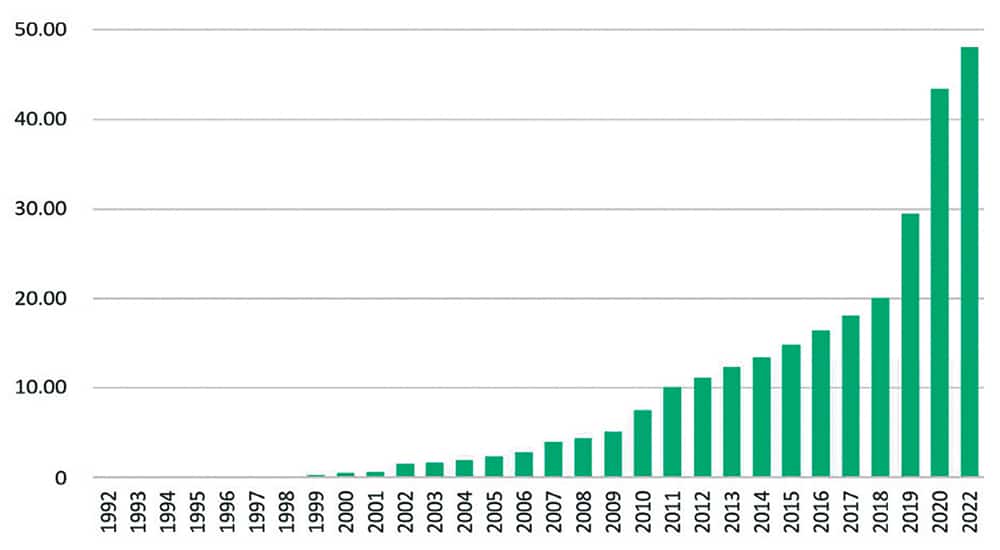
Aadhaar, UPI, CoWIN, and India Stack show India can deliver population scale systems. (See Fig. 2 for how the internet users have grown in India.) UPI alone handles billions of monthly transactions.
Global talent
Indians lead major technology companies and research labs. The diaspora thrives in Silicon Valley and other hubs.
Entrepreneurship
With more than a hundred unicorns, India has one of the largest startup ecosystems. It is still skewed to services, yet fertile ground exists for deep technology.
These are raw ingredients. The challenge is to align them into a coherent national mission.
| Table 1: Demographic profile – India vs peers (2024) | |||
| Country | Median Age | Working-Age Pop. % | Dependency Ratio |
| India | 28 | 67% | 0.5 |
| China | 39 | 61% | 0.6 |
| USA | 38 | 65% | 0.5 |
| Japan | 49 | 56% | 0.7 |
The risks of falling short
The risks are real. India could falter if it does not confront systemic barriers.
Corruption and black money
Distorted incentives reward influence over ideas and choke innovation.
Infrastructure gaps
Power outages, congested roads, and unreliable logistics reduce competitiveness.
Educational disparity
Too many children complete primary school without basic literacy or numeracy. This is a national emergency. Read why education is India’s first step towards the #1 Economy.
Innovation bottlenecks
Current patent interpretation excludes software as such, which limits defensible intellectual property.
Also read: How Innovation and IP Ownership Can Transform India’s Economy.
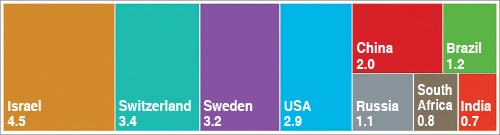
According to NITI Aayog, India’s R&D spending has hovered at a mere 0.7% of GDP, and far below peers like China or Israel (Fig. 4).
Without correction, India risks becoming a perpetual services provider rather than a leader that shapes global technology and trade.
The education imperative
Economic leadership begins in classrooms. Nations do not innovate when their children cannot read, calculate, or ask questions with confidence.
A diode behaves the same everywhere, but its teaching differs widely between a top laboratory and a small town college classroom. India must embrace One Nation, One Education so that opportunity is not defined by geography. Standardised quality, bilingual fluency, and a national Mission Maths must become non-negotiable.
| Table 2: Competitiveness and governance indicators | ||||
| Indicator (latest) | India | China | USA | Singapore (best practice) |
| Ease of Doing Business (2020)* | 63rd | 31st | 6th | 2nd |
| Competitiveness Index (2019) | 40th | 28th | 2nd | 1st |
| Corruption Perception (2023) | 93rd | 80th | 24th | 5th |
Aligning innovation and integrity
For India, the choice is distinct: remain a large emerging economy, or step into its rightful place as the world’s foremost economic power by 2040. This is not only about pride or rankings. It is about survival, sovereignty, and responsibility.
Unless reformed, India will lose not for lack of talent, but for lack of foresight. The paradox is striking. India produces world-class coders, yet its own laws often leave them without defensible intellectual property. The result is predictable. Investors hesitate, startups migrate filing to other jurisdictions, and India remains an outsourcing hub instead of an intellectual property leader.
A framework for national alignment
Economic leadership is a system design problem.
- Education builds talent.
- Innovation converts talent into industries.
- Industry generates wealth and jobs.
- Governance ensures fairness and stability.
- Sovereignty protects independence and influence.
Idea one
Set measurable national milestones: universal foundational literacy by 2030, higher-education enrolment above 45-55%, stronger STEM (Science, Technology, Engineering, and Mathematics) participation, and a clear pathway for software and algorithm-enabled patents.
Idea two
Build sovereign capability where dependence is dangerous.
Semiconductors: From materials research and equipment to packaging and design
Compute and storage: Green data centres integrated with renewable power and grid scale storage
Power electronics: High-efficiency inverters, converters, and chargers designed and built in India
Defence AI: Satellite intelligence, border surveillance, secure communications, and decision support built on Indian platforms
Health and agriculture AI: Diagnostics, disease surveillance, crop and water intelligence tuned to Indian languages and conditions
Idea three
Integrity is an economic multiplier.
Digitise approvals and licensing with audit trails. Protect whistleblowers. Publish transparent procurement dashboards. Enforce timely government payments to MSMEs.
Strategic case for #1 economy
In a century defined by technology, India cannot remain an adopter of other people’s platforms and standards. It must build its own. Leadership provides resources to protect borders, invest in fundamental research, and influence trade and technology rules.
Vision for 2040
By 2040, leadership depends on four outcomes.
- Educate with confidence, fear-free
- Protect innovators with law and patient capital
- Power industries with reliable infrastructure
- Clean, predictable governance
Closing note
This is not optimism by habit. It is confidence by design. India already has proof points at scale in digital identity and payments, in space and pharmaceuticals, and in the grit of its entrepreneurs. Our task is alignment: classrooms with laboratories, laboratories with factories, factories with markets, and markets with clean rules. If we do this with focus and urgency, India will not only read the rules of the twenty-first century, it will help write them.
Janardhana Swamy is an electronics engineer, inventor with patents in India and the USA, and a former Member of Parliament from Chitradurga. This series draws on his rare blend of technical depth, global experience, and lifelong passion for India’s leadership.


