The new type of glass clears dust in seconds without water or chemicals. It could change how we keep windows, vehicles, and solar panels clean.
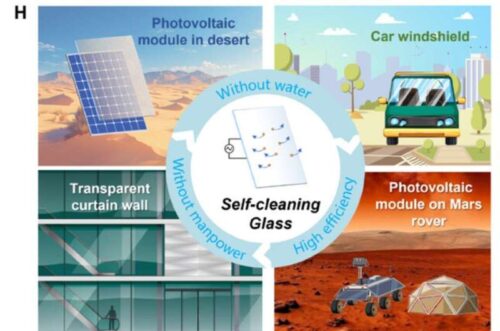
Researchers in China have developed a transparent, easy-to-make glass that can remove particles in 10 seconds using an electric field. The method works without water and can be applied to buildings, vehicles, and even solar panels on Mars rovers. Tests showed the glass could clean both organic and inorganic particles, achieving over 95% efficiency in seconds.
The transparent, coat-able self-cleaning glass removed 97.79 g/m² of particles in 10 seconds with 97.5% efficiency using a square wave electrical signal (5 kV, 10 Hz). While the electric field was active, it also acted as a shield to prevent new particles from settling.
Its sandwich-like design includes a quartz glass base supporting indium tin oxide (ITO) electrodes patterned by laser etching. A polyethylene glycol terephthalate (PET) film serves as an insulating dielectric layer over the electrodes.
Researchers studied how particles move and detach under electric fields, identifying two main behaviors in charged particles—abnormal reverse lateral movement and jumping. They analyzed the forces involved, including Coulomb and dielectrophoretic forces that move particles and van der Waals forces that keep them stuck.

This work addresses limitations of earlier self-cleaning surfaces inspired by nature, such as lotus leaves and cicada wings, which rely on superhydrophobic properties and often depend on weather factors like humidity. It also overcomes challenges with electrostatic cleaning, which works for airborne dust but struggles with particles stuck to surfaces.
Dust accumulates from geological sources like wind erosion and pulverized rocks, biological sources like pollen and spores, and human activities like construction and mining. This buildup reduces window clarity and lowers solar panel efficiency. Traditional cleaning with water and detergents consumes resources, pollutes, and poses safety risks, especially on tall buildings.
The result is a self-cleaning glass that works in dry, harsh environments on Earth and in space, maintaining performance without affecting function or light transmission, and using a sustainable, chemical-free process.