As software becomes the driving intelligence behind mobility, the real competition will centre on adaptability, trust, and the ability to continuously evolve long after the vehicle leaves the factory.
A vehicle is no longer just a mode of transportation; it is rapidly becoming an intelligent, adaptive environment that evolves with its user. Imagine stepping into a car already aligned with your day: the cabin calibrated to your comfort, navigation anticipating your route, and systems quietly optimised overnight through invisible software updates. No mechanic intervened, no hardware changed, yet the machine feels fundamentally improved.
This is not a distant vision; it is the emerging reality of software-defined vehicles (SDVs), a transformation quietly reshaping the automotive industry at its core. For more than a century, automotive innovation was defined by mechanical excellence, engine performance, structural precision, and manufacturing scale. Today, that paradigm is beginning to dissolve. Industry leaders such as Tesla, Mercedes-Benz, and BMW are redefining the automobile as a computational platform—an evolving fusion of software, electronics, and data. As SDVs become increasingly prevalent, regulatory bodies and industry standards are also evolving to address safety, cybersecurity, and interoperability concerns, ensuring these vehicles operate reliably across diverse markets and systems.
What makes a vehicle ‘software defined’?
Arpit Chahande, CEO, Yellow Matrix Private Limited, states, “At its essence, an SDV is one whose capabilities are not frozen at the moment of purchase but are continuously shaped and enhanced through software. Unlike traditional vehicles, where features are rigidly tied to hardware configurations, SDVs introduce a dynamic layer where functionality can be modified, upgraded, or entirely reimagined long after the vehicle leaves the factory.”
This fundamentally alters the ownership experience. A car becomes less of a static asset and more of an evolving digital system. Performance can be fine-tuned, new features introduced, and the user experience personalised in increasingly sophisticated ways. Companies such as Tesla have already demonstrated how vehicles can deliver tangible improvements, from acceleration boosts to advanced driver-assistance capabilities, through software updates alone. This evolution into learning, adaptive platforms encourages optimism about vehicles that grow smarter and more capable over time.
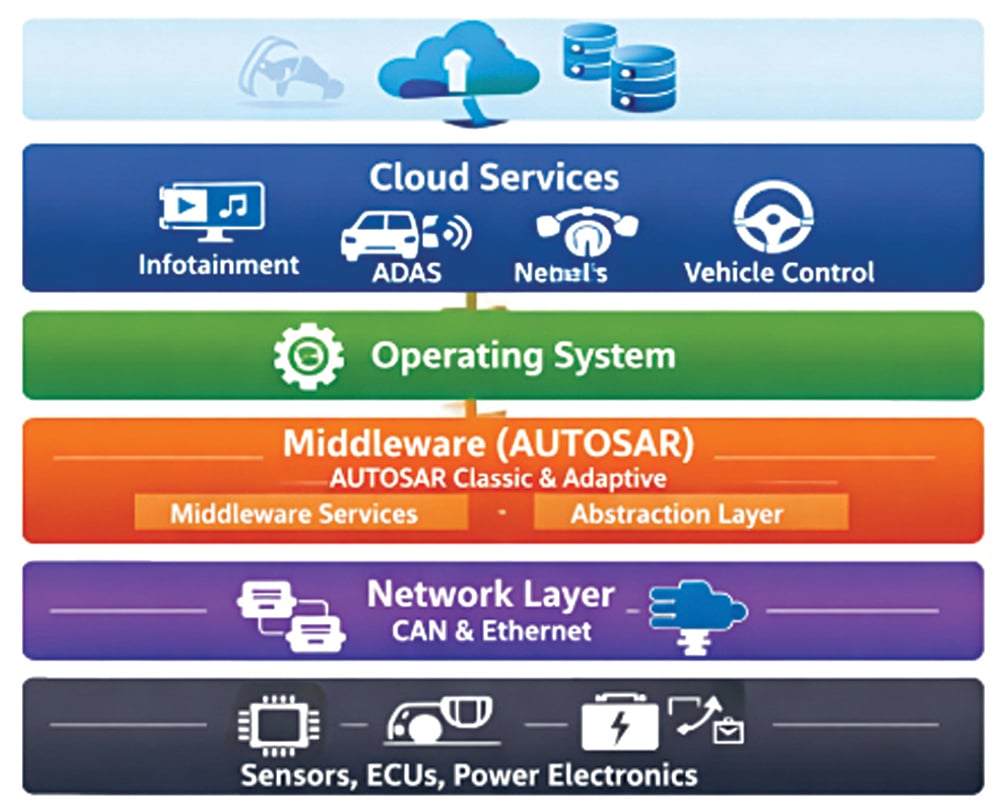
The rise of SDVs is made possible by a profound transformation in vehicle architecture. Traditional cars relied on a fragmented system of dozens of electronic control units (ECUs), each responsible for a specific function and connected through complex wiring networks. This approach, while effective in the past, created rigid systems in which innovation was slow and integration cumbersome. Modern vehicles are moving towards centralised computing architectures built around high-performance processors and zonal designs. Instead of dozens of isolated controllers, a few powerful computing units now orchestrate the entire vehicle. This shift simplifies hardware complexity while enabling unprecedented software flexibility. Companies like Tesla and Rivian have embraced this approach, designing vehicles more like distributed computing systems than mechanical assemblies. The result is a platform where software can be updated rapidly, features can scale seamlessly, and innovation cycles are dramatically accelerated.
| When software turns cars into living products |
| An SDV is not just a concept—it is already reshaping how cars behave, generate revenue, and evolve in the real world. • Performance upgrade without touching hardware: A customer purchases a car with standard acceleration, but months later a software update unlocks faster acceleration without any mechanical changes. This enables the same hardware to deliver higher performance, allows manufacturers to monetize features after the initial sale, and extends the vehicle’s lifecycle value. • ‘Dog mode’ and cabin intelligence: A parked vehicle uses software to maintain a safe cabin temperature, monitor internal conditions, and display safety messages. This enhances safety without additional hardware, builds emotional trust with users, and turns small software-driven features into meaningful brand differentiators. • Over-the-air (OTA): Vehicles now receive over-the-air updates that can fix bugs, improve battery efficiency, or even add entirely new features overnight. Modern cars already run over 100 million lines of code, with future autonomous systems expected to exceed 500 million. This shift eliminates dependence on dealerships, enables continuous performance improvement, and significantly reduces recall costs. • AI-driven personalisation: The vehicle learns driver habits such as preferred temperature settings, driving style, and frequent routes, and automatically adapts over time. This creates a personalised experience without manual input, improves user satisfaction and retention, and enables continuous, data-driven feature evolution. • Predictive and connected ecosystems: Fleet vehicles leverage geofencing, real-time alerts, and predictive maintenance to optimise operations, reducing downtime, lowering costs, and improving safety and efficiency. Unlike traditional cars that depreciate immediately after purchase, SDVs can improve over time, gain new capabilities, and generate continuous revenue. It is no longer just a product. It is a platform that evolves. |

Under the hood: A new technology stack