





This sensor withstands repeated cuts, restoring electrical and mechanical properties with minimal performance drop.
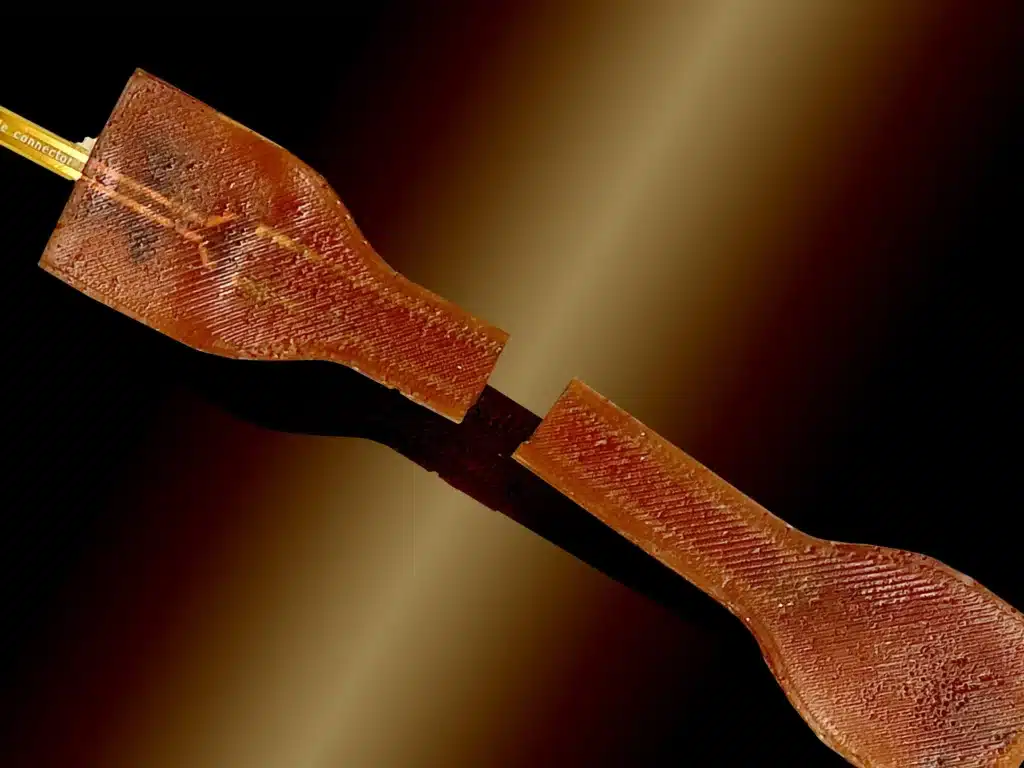
Researchers in Belgium have developed a stretchable sensor that continues to function even after being completely cut in half and rejoined. The sensor can restore both its structural and electrical properties multiple times without major performance loss. The development was reported in the IEEE Sensors Journal.
The device integrates a conductive liquid metal alloy with a polymer matrix that enables self-healing. This approach addresses a common reliability issue in stretchable electronics used for soft robotics, rehabilitation monitoring, and human–machine interfaces.
The polymer matrix uses a chemical bonding method known as Diels–Alder crosslinking. This mechanism forms reversible covalent bonds between two specific molecular components, a diene and a dienophile. When subjected to heat or mechanical stress, these bonds break without degrading the material’s base structure. Once the damaged parts are re-aligned, the bonds can reform, effectively allowing the material to “heal” itself.
The embedded conductor is Galinstan, a eutectic alloy of gallium, indium, and tin. Even when the sensor is torn, Galinstan remains mostly contained due to the formation of a surface oxide layer that temporarily seals the cut. Once the material is physically reconnected, this oxide barrier is disrupted, and conductivity is restored.
The sensor retained nearly 80 percent of its signal integrity after six complete cut-heal cycles. Drift tests showed that even after 800 stretching cycles, healed devices maintained signal accuracy within a 10 percent margin.
Over 95 percent of the material components can be recovered and reused. This makes the device suitable for sustainable electronics applications.
The researchers have launched a commercial entity, Valence Technologies, to scale and deploy the sensor in sectors including wearable health tech, soft robotic actuators, and motion tracking systems.

