





IoT gateways are more than just a piece of network hardware; they serve as the control point that ensures data flows securely, efficiently, and in a business-ready format.
In large-scale IoT deployments, it is difficult to send data from IoT devices directly to the cloud because the network environment is not always connected to the internet, and protocols other than TCP/IP may govern IoT device operations. This is where the IoT gateway comes in, allowing data from multiple IoT devices or other embedded devices using different protocols to gather in one place before being sent to the cloud.
Importance of IoT Gateway
In any IoT ecosystem, the gateway is as critical as the devices themselves. It acts as a central hub, managing communication between multiple devices, consolidating data, and ensuring secure transmission to the cloud.
Its core functions include connecting devices that use different communication protocols and translating them into formats the cloud can accept. For instance, a device operating on the Zigbee protocol cannot send data directly to the cloud; it must first connect to the gateway via Zigbee, which will then transfer the data to the cloud.
The same applies to Bluetooth low energy (BLE) devices. These can only operate within a Bluetooth network, so they connect to the gateway via BLE, which then transmits their data to the cloud.
Case study: Vibration monitoring in elevators located in airports
In many large facilities, security policies and environmental conditions dictate how connected devices can operate. For example, the use of Wi-Fi is restricted in airports.
In this case, the project involved monitoring lifts, with the objective of tracking lift performance and safety using IoT sensors, without relying on Wi-Fi to communicate between devices and the cloud.
The business challenge was clear: lifts can experience sudden faults, such as unplanned acceleration, that pose safety risks and potential downtime costs. To address this, a sensor suite was installed in each lift, including magnetometers, accelerometers, and gyroscopes. These captured movement data across the X, Y, and Z axes to detect vibrations or anomalies in operation.
The complication came from the deployment environment. In locations like airports, where the project was piloted, Wi-Fi is heavily congested, and additional devices risk interfering with critical communication channels. The operational requirement was explicit: no Wi-Fi connections were allowed in the lift area.
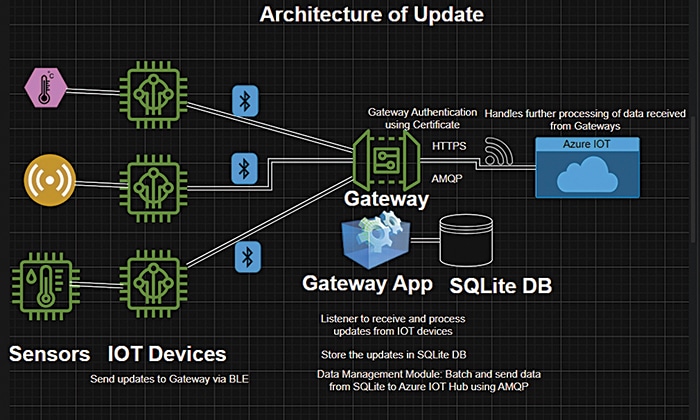
To meet this constraint, the sensors were connected to IoT devices powered by microcontrollers such as the ESP32 and STM32. These devices interfaced with the sensors via SPI (serial peripheral interface) and stored the collected vibration data locally. The data was then transmitted using BLE to an IoT gateway positioned within range.
The gateway handled aggregation and secure transmission of the data to the cloud, where it could be analysed for predictive maintenance and safety compliance. This setup also enabled over-the-air (OTA) updates, allowing firmware upgrades to IoT devices without physical intervention, thereby reducing maintenance time and ensuring systems remained up to date.
From an operational perspective, this design achieved compliance with local network restrictions, safeguarded lift performance, and provided a framework for proactive fault detection—all without introducing interference risks.
| Git repository |
| If you search the internet or use ChatGPT, can a Git repository be used to store the image? It will say No, don’t use the Git repository for images. But why in the IoT gateway Git repository is used for images? Because it is constrained by time. But that did not work out for the allotted timeline. For a quicker solution, GitHub provides a more secure space and puts the image in the Git repository. For IoT devices, the data is uploaded to the firmware in the Git repository. |
Data Storage
In the lift-monitoring project, BLE was used as the communication link between the IoT devices and the gateway. The BLE chip within each device ensured that vibration data collected from the sensors was transmitted to the gateway without relying on Wi-Fi.
Once received, the IoT gateway temporarily stored the incoming data in an embedded database. This design choice was not simply technical; it had clear operational advantages. By storing data locally, the gateway could batch transmissions to the cloud at set intervals rather than sending data continuously. This approach reduced network overhead, minimised bandwidth costs, and safeguarded against data loss during temporary connectivity issues.
An embedded database is a built-in storage system inside an IoT gateway that holds sensor data locally before sending it to the cloud. It saves bandwidth, prevents data loss during outages, and ensures smooth, reliable monitoring.
OTA Updates and Swap Memory
The same gateway also supports OTA firmware updates, allowing engineers to roll out security patches or new features without physical access to the devices.
Typically, OTA relies on dual-partition disks, allowing the device to switch to a new firmware image while retaining the current one as a fallback. In some embedded systems, this is not possible due to hardware limitations—a factor that must be considered during project scoping.
For business leaders, OTA represents faster deployment cycles, reduced service costs, and lower operational risk when updating field equipment.
Chunking Data into Smaller Packets before Transmitting
In low-bandwidth environments, large firmware images cannot be sent in one go without risking failures or slowdowns. The solution is chunking, which involves dividing the image into smaller packets that are easier to transmit. Each packet is assigned a checksum, allowing the system to verify data integrity before reassembling the complete image.
In the lift-monitoring deployment, the gateway application retrieved the latest firmware from a Git repository, split it into chunks, and sent them to the IoT devices over BLE. The devices then reconstructed the image, validated it through checksums and signature checks, and installed it. This ensured reliable updates despite bandwidth and processing limitations.
IoT gateways are not just technical infrastructure; they are a strategic enabler for large-scale business operations. By consolidating device data, translating protocols, securing communications, and enabling remote management, they bridge the gap between efficient and fast data transmission.
This article is based on the session from India Electronics Week 2025, titled IoT Gateway, delivered by Chandrasekar Balasubramanian, Senior Consultant, IITM Pravartak. The session was transcribed and curated by Janarthana Krishna Venkatesan, a journalist at EFY.
