




Projectors have come a long way. With laser technology and AI built in, they are quietly taking over the living room. Still think TVs are better? Read on.
Table of Contents
Projectors today are no longer just projectors—they are evolving into what many now call ‘screenless TVs.’ Thanks to major advances in display technology, modern projectors deliver visuals that closely rival traditional televisions. A key innovation driving this shift is Advanced Laser Phosphor Display (ALPD) technology. Now in its fifth generation, ALPD produces images so sharp and vivid that it is often difficult to tell whether you are watching a projection or a television screen.
Alongside ALPD, two other technologies are gaining ground: Trichroma laser and triple MALC (Microstructure Adaptive Laser Control) laser. Both prioritise highly accurate colour reproduction—capturing visuals exactly as the director intended, with vivid detail and natural tones. Together, ALPD, Trichroma, and MALC triple-colour lasers are leading a new era in projection technology.
What sets these new-age projectors apart is their flexibility. Designed for modern living, they can move easily from room to room, project on various surfaces—including walls and ceilings—and adapt to changing light conditions. Whether it is a 101.6cm (40-inch) display by day or a 254cm (100-inch) cinematic experience at night, today’s projectors deliver crystal-clear images with unmatched convenience.
Laser Tech vs TV
Only a few companies globally are using the latest laser-based projection technologies, which are transforming image viewing. For decades, projectors were dominated by legacy brands whose models often exhibited visible pixels and speckling, particularly on large screens. That has changed. Today’s high-end projectors, often called ‘lifestyle screenless televisions,’ deliver visuals that rival traditional TVs.
At the heart of this transformation is ALPD, which improves both image quality and energy efficiency. Whereas older models depended on very high brightness to overcome ambient light, ALPD achieves vivid colours at lower brightness levels—thanks to a more efficient light engine—delivering better visuals with reduced energy consumption.
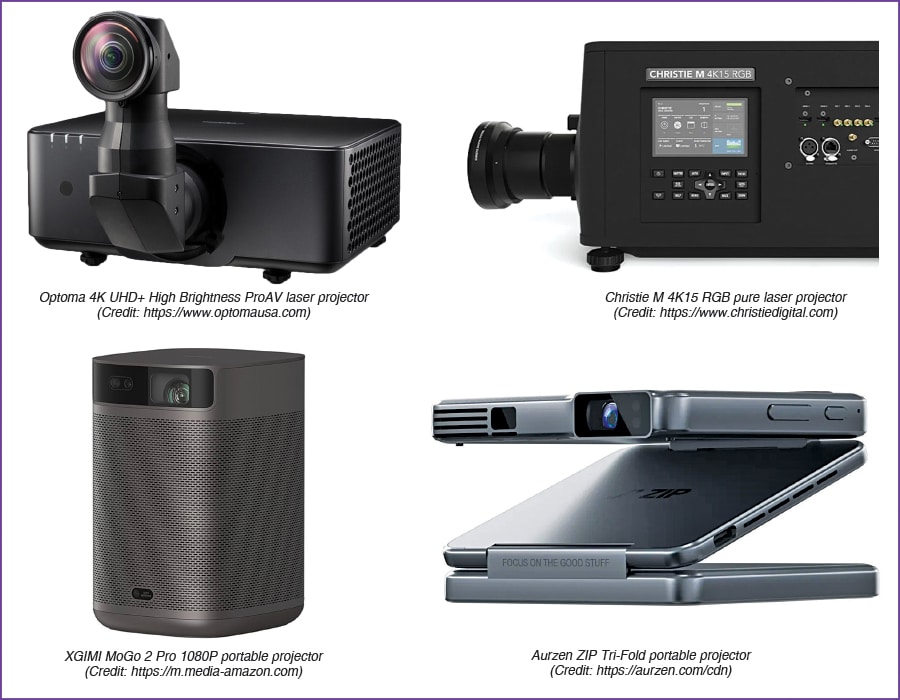
For example, Optoma laser projectors use lasers to create the image. In many situations, the brightness of a laser model can appear nearly twice as bright as that of a lamp-based projector.
Alongside ALPD, two other technologies—Trichroma laser and MALC laser—are gaining ground. Both use RGB (red, green, blue) laser light to achieve lifelike colour reproduction. The key difference lies in their design. ALPD supports both single- and triple-laser MALC systems, while Trichroma and MALC are purely triple-laser platforms. Think of them as different operating systems—distinct in build but similar in output.
A major challenge in triple-laser systems is aligning the three colour channels. However, with the help of AI and improved software, calibration is now much easier. Modern projectors let users fine-tune individual colours and switch between preset modes like Dynamic, Vivid, and Sports. Advanced options, such as Filmmaker Mode, Director’s Cut, IMAX Enhanced, and Dolby Vision, automatically adjust colour and tone to match the content’s original look. For example, when streaming a high-resolution film like Avatar, the projector uses Dolby Vision to fine-tune colour in real time.
One simple example is the Christie M 4K RGB projector. It uses RGB laser light, displays 4K images, and features smart capabilities to accurately align colours.
Despite different names and designs, all three share a common goal: better colour, clarity, and image quality, making today’s projectors a strong alternative to traditional televisions.
Projectors in your pocket
Mini and pocket projectors—often called pico projectors (short for ‘picture in, carry out’)—are reshaping how people watch content on the go. Small enough to fit in a bag or pocket, these compact devices are making projection more mobile and accessible.
A standout example is the MoGo projector, launched by XGIMI in 2020. About the size of a small loaf of bread, it combines built-in AI, Google TV, and Bluetooth speakers—essentially a smart TV you can carry anywhere.
Another model in the pocket-size category is Kodak’s Luma 75, known for its compact design and basic use for small projection on the move.
Most mini projectors use LCD or LED DLP technology, keeping them lightweight, cost-effective, and power-efficient. While premium versions incorporate laser systems, pocket-sized models favour simplicity to maintain portability.
A newer entry is the Flip Projector from Aurzen. About the size of a Samsung flip phone, it stands upright in a Z-shape. It does not have a built-in OS, but mirrors content wirelessly from a smartphone. Just set it down, point it at a wall, and start streaming.
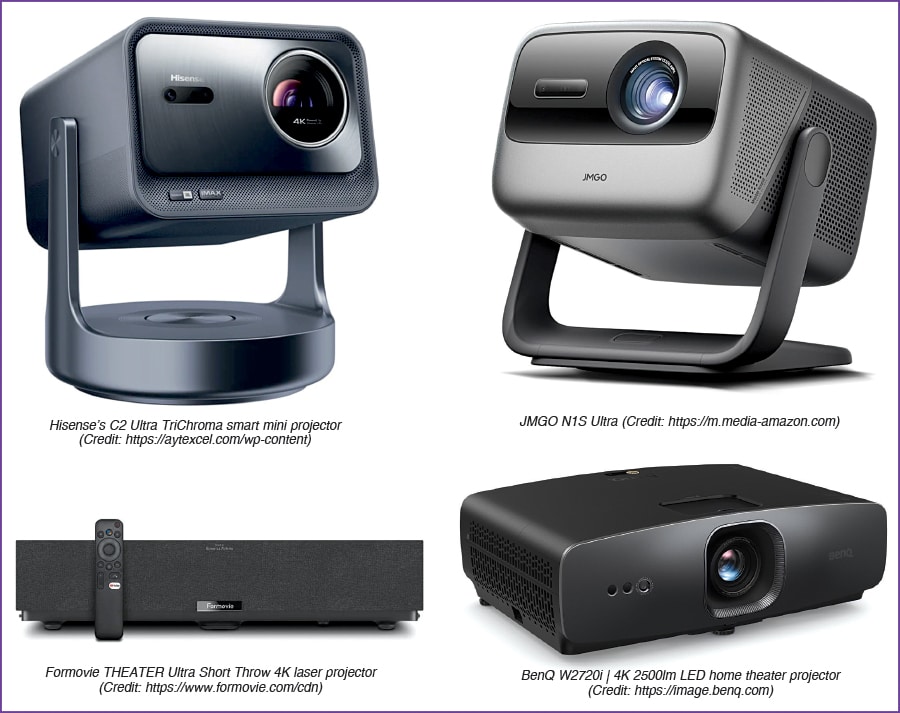
For those looking for sound and image in a portable form, Hisense’s C2 Ultra is a room-to-room model that adds audio without requiring speakers.
While they cannot match full-sized projectors in performance, pico projectors offer unmatched convenience, ideal for travel, casual viewing, or quick movie nights. As they evolve, they are redefining how and where we watch content.
Ultra-short-throw Projectors
Ultra-short-throw (UST) projectors can display a large image from a short distance. For example, the Epson 4K PRO-UHD1 can project an 203cm (80-inch) picture from just 2.3cm away, and can scale up to 381cm (150-inch) with a slight increase in distance.
With standard projectors, people often stand between the projector and the screen, blocking the image and causing glare. UST projectors avoid this by being placed in front of the viewing area, close to the wall. This keeps the picture clear and the light out of the viewers’ eyes.
Interactive models often use UST technology, enabling users to write or draw on the image, control a computer from the wall display, or share visuals across networked projectors.
UST projectors have become increasingly common. Positioned on a table near the wall, they can display images larger than 2.5-metre (100-inches). Setup is quick, brightness is high, and many manufacturers now offer them.
One example is the Formovie THEATER, a 2800-lumen UST projector with built-in Android TV that operates without any additional media box.
UST projectors cost more than standard ones. The internal components are similar, but the lens is more complex, enabling projection of large images from very short distances. They work well in tight spaces, sometimes just 30cm (1 foot) from the wall, with throw ratios between 0.25:1 and 0.5:1.
| Adoption of advanced projection technologies |
| Apotronics, a global leader in laser projection and a 60% partner in Formovie (with Xiaomi holding 40%), introduced ALPD—used in over 100,000 cinema halls—into the home projector market. This commercial-grade technology reduces pixelation, rainbow artefacts, and visual noise in home cinema. • Formovie: First to bring ALPD to home projection (2021) • JMGO (Jimgo): Uses its own Triple MALC Laser tech • Hisense: Developed Trichroma Laser technology; also manufactures for other major projector brands New-generation ‘screenless TVs’ offer significantly better image quality compared to older projectors. The difference is visible in clarity, brightness, and colour precision, marking a sharp divide between traditional and modern projection systems. |
Projectors with AI Inside
Artificial intelligence has long been part of smart projectors, but its role has expanded significantly in modern models. Early projectors required manual setup, especially when projecting from an angle, which made alignment and focusing time-consuming. That is no longer the case.
Today’s lifestyle projectors use AI to auto-correct and optimise the image. Whether tilted to the side or pointed at the ceiling, the projector detects the surface and adjusts the frame to a perfect 16:9 aspect ratio. Screen detection eliminates the need for manual alignment; press a button, and the image fits the screen in under 10 seconds. Focus and keystone corrections are made instantly.
For instance, the BenQ W2720i uses a built-in camera to assess ambient light and adjusts the screen image accordingly, functioning seamlessly in both bright and dim rooms.
JMGO projectors use triple-laser MALC engines to ensure colour accuracy and consistent brightness. AI-powered auto-alignment with a motorised gimbal simplifies setup, demonstrating how smart features are transforming projector usability.
Another valuable feature is object avoidance. If a plug-socket or piece of wall décor blocks part of the surface, the projector detects it and shifts the image accordingly, no manual input required.
AI also enhances content quality. Built-in processors adjust settings for viewing modes like Sport, Dynamic, or Vivid. Advanced features such as IMAX Enhanced, Dolby Vision, Director’s Cut, and Filmmaker Mode apply colour and contrast profiles as intended by content creators.
These projectors are entirely wireless, except for power, and operate on platforms like Google TV or VEDA. Once connected to Wi-Fi, they function like smart TVs. A voice-enabled remote allows users to search for content with commands like ‘Show me Tom Cruise movies,’ returning results across various apps, including Netflix, Prime Video, Disney+, and more.
Today’s smart projectors are not just about image, they are about convenience, intelligence, and seamless integration into digital lifestyles.
| What should you know before buying a projector today? |
| • Define the purpose: Start by understanding your needs. If you’re seeking a true TV alternative, focus on ultra short throw laser TVs, not just traditional projectors. • Know the global shift: In the West and parts of Asia, 250cm to 300cm (100-120 inch) TVs are used mainly for commercial displays. For homes, laser TVs are gaining popularity due to their superior visuals, enhanced eye comfort, and portability. • Growing awareness in India: Laser TVs entered India around 2019, and interest is rising. Consumers are researching more, and demand is growing—especially for compact, smart, large-screen alternatives. • The experience gap: Many regret buying large LCD/LED TVs after experiencing modern laser projectors. The jump in size, comfort, and built-in sound is convincing more users to switch. • What’s ahead: While current models don’t replace all TVs, the next wave—due within a year—could make screenless TVs a serious choice for many households. |
Can projectors replace large TVs?
Projectors have long taken a back seat to TVs in home entertainment, but that is beginning to change, particularly for those wanting screens larger than 2.5-metre (100-inches). While 140cm to 190cm (55- to 75-inch) TVs remain popular, an increasing number of consumers are opting for projectors to enjoy an immersive, cinema-style experience.
However, not all projectors can replace a television. For a 140cm (75-inch) display, a TV may still be the more practical choice. However, for screen sizes above 250cm (100-inches), modern projectors—especially ultra-short-throw models—offer distinct advantages. Brands like Dangbei, Valerian, JMGO, and Hisense now offer laser projectors that produce bright, high-resolution images directly onto walls or screens. While they can project onto bare walls, pairing them with a quality screen enhances performance, rivaling premium TVs from LG, Samsung, or Sony.
Comfort is another key benefit. Large TVs emit heat and direct light, which may strain the eyes. Projectors reflect light, creating a softer, more eye-friendly experience. They are also more portable, a 250cm (100-inch) TV is bulky and hard to move, whereas a projector can be unplugged and carried like a large laptop.
Image quality, however, depends heavily on the screen used. Standard matte white screens, commonly found in offices, often fail to showcase the capabilities of modern laser projectors. Fresnel screens, built with layered optics that include a Fresnel lens, enhance clarity and brightness. The result can resemble a backlit TV, with some users describing it as a complete visual upgrade.
While projectors are unlikely to replace smaller TVs anytime soon, for large-format home viewing, compact laser projectors combined with high-quality screens now present a compelling, and often superior, alternative.
What comes next?
Smart features have become standard in today’s laser projectors. Built-in platforms like Google TV, AI enhancements, filmmaker modes, and premium audio are now expected. While current models are already advanced, there is still scope for improvement in size, portability, and daily usability.
In India, however, awareness remains relatively low. Many still associate projectors with bulky, outdated models used in classrooms or conference rooms. In reality, today’s home projectors are compact, intelligent, and capable of replacing large TVs. The leap in brightness, image clarity, and usability compared to older models is significant.
Audio quality has also improved. Early smart projectors featured Harman speakers, later replaced by Denon and Dynavox. The next generation will include integrated speakers from Divya Lane, a European brand. Many current models already support Dolby Atmos for virtual surround sound. Upcoming systems will support single-connection speaker setups, eliminating the need for a separate AV receiver and simplifying installation.
Visually, modern laser projectors significantly outperform older models. While core mechanics have not changed dramatically, user experience continues to improve through innovation. These devices are no longer just display tools—they are becoming all-in-one entertainment hubs for the home.
Projectors have evolved far beyond their traditional role. They have emerged as powerful, flexible, and intelligent alternatives to large-screen televisions. Powered by technologies such as ALPD, Trichroma, and MALC, today’s laser projectors deliver cinema-grade visuals with enhanced portability, integrated smart features, and AI-driven ease of use.
Whether it is a compact pico projector for mobile streaming or a short-throw model for immersive home viewing, the move toward screenless televisions is well underway. As awareness grows and adoption spreads, projectors are set to become not just replacements for big TVs but a redefinition of how we experience visual content at home.
This article is based on a conversation with Sushil Motwani, founder of Aytexcel Pvt Ltd and official India representative for Formovie projectors, who has helped bring projection technology to users in India. Co-author, Nidhi Agarwal is Senior Technology Journalist at EFY with a deep interest in embedded systems, development boards, and IoT cloud solutions.

