

Apple, Microsoft, Amazon, Google, Infosys, Wipro—global and Indian firms are heading closer to achieving net-zero emissions, a mandate to combat climate change. Here is what you need to know to start your journey…
Table of Contents
While it is important to be conscientious year-round, the end of every year has a way of awakening the do-gooder in every CXO who has been busy chasing corporate goals. Many of you are probably charting your social and environmental responsibilities for the coming year, and if you are, make sure to include well-defined efforts towards achieving net-zero emissions, because it is no longer a choice!
The Paris Agreement, a legally binding international treaty adopted in 2015, aims to limit global warming to below 1.5°C. To achieve this, emissions need to be reduced by 45% by 2030 and reach net-zero by 2050.
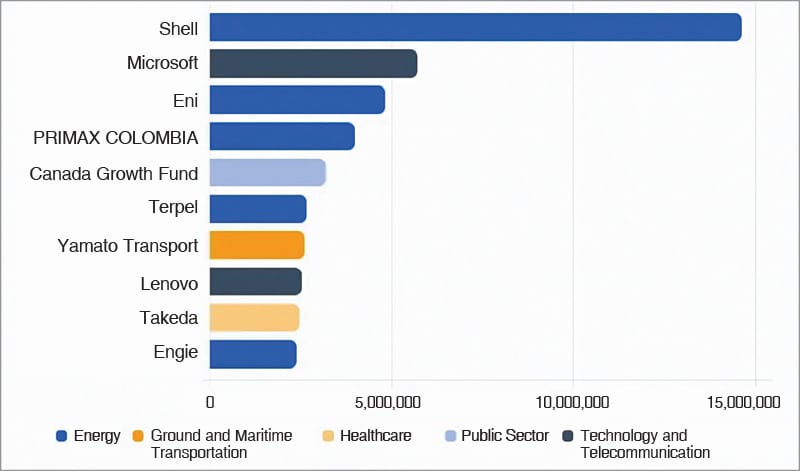
While many tech majors, including Apple, Google, Microsoft, and Indian players like Infosys, have taken up the challenge full-on and hope to go net-zero within the next decade, many companies are still lax in their efforts, and some have hardly given it a thought.
Here are some details that will set you thinking and help you plan your course of action.
Carbon Footprints in the Sands of Time
Carbon footprint is the total amount of greenhouse gases (GHG) emitted by an entity (a product or an organisation), including both direct and indirect emissions. From a company’s perspective, these emissions are broadly classified as scope 1, 2, and 3.
Scope 1 refers to emissions from sources owned or controlled by the company. This includes emissions from their products, vehicles, or furnaces, as well as from their manufacturing facilities.
Scope 2 refers to indirect emissions from purchased energy, that is, fuel burnt somewhere to supply the energy they use from the grid.
Scope 3 refers to indirect emissions that happen across the company’s value chain, both upstream and downstream, such as emissions during the extraction or production of materials bought by the company, energy used by resellers in their showrooms, emissions due to the use of the company’s products by end-users, emissions during their end-of-life disposal, and so on.
Scopes 1 and 2 are under the highest scrutiny. In some countries, companies are required to report their scope 1 and 2 emissions and may also have to pay a carbon tax.
Scope 3 is more complex because it involves many entities not under your direct control, making it difficult to implement changes there. In many countries, addressing scope 3 emissions is not mandatory, but many Fortune 500 companies have voluntarily committed to tackling them.
The first step towards an organisation’s net-zero journey is, therefore, understanding and quantifying its carbon footprint. Once that is done, they need to decide which approach they will take to make this net-zero.
Net-zero vs Carbon Neutrality
The two are different. Carbon neutrality involves balancing or offsetting a company’s emissions with corrective measures after the damage is done. Without breaking their heads over improving their processes and products, companies can simply neutralise the effects of their emissions by funding projects such as mangrove afforestation, and soil sequestration, which reverse the effects of GHG emissions. Invest in enough projects to totally neutralise the ill effects of your emissions, and you become carbon neutral.
But net-zero is a more intense commitment that involves decarbonisation (revamping your products and processes to prevent as much emission as possible), compensating for whatever damage has been done, and voluntarily improving the ecosystem. While a company may start with carbon neutrality goals, net-zero must be the ultimate target.
The net-zero approach involves reducing a company’s emissions in every possible way using renewable energy, recycled materials, optimising fleets, encouraging employees to go green, and so on.
| India’s Carbon Credit Trading System |
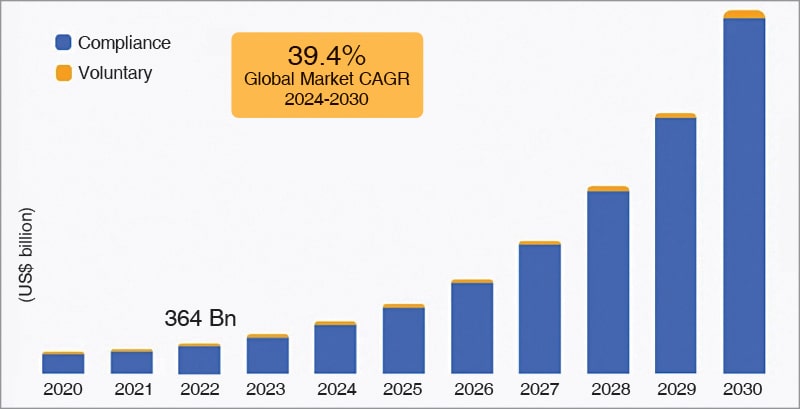
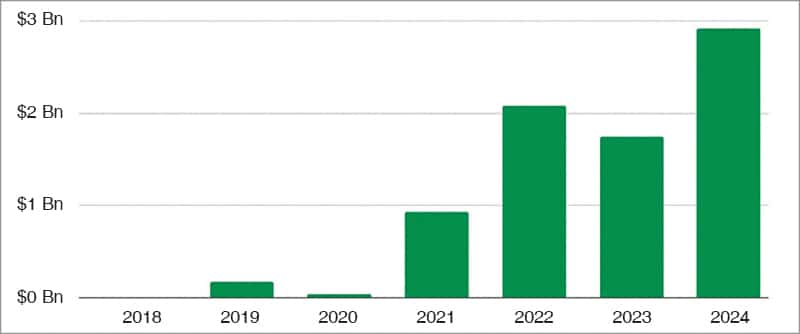
| • India’s Carbon Credit Trading Scheme (CCTS), which lays the foundation for the Indian Carbon Market (ICM), was introduced under the Energy Conservation (Amendment) Act, 2022, and is expected to start compliance trading from mid-2026. • The unit of trade in the ICM is a Carbon Credit Certificate (CCC), which is equal to one metric tonne of carbon dioxide. • India has opted for a baseline-and-credit approach to carbon credit trading. • The CCTS is managed by the Bureau of Energy Efficiency (BEE), which sets the baselines, verifies credits, and issues CCCs. • The BEE assigns emission reduction targets to obligated entities (in energy-intensive industries), under the guidance of a national steering committee. Entities that outperform the targets earn carbon credits, which they can sell to those that fall short of the requirements to comply. • CCCs will be traded on national power exchanges. The Central Electricity Regulatory Commission will regulate trading activities within the ICM, while the Grid Controller of India will act as the registry operator, maintaining records of obligated entities and trading transactions. • India’s carbon trading scheme involves both a compliance market for certain industries and a voluntary offset market for other entities. Voluntary projects like afforestation, renewable energy, and clean cooking generate CCCs. These non-obligated entities can then sell the credits, creating a secondary market. • The CCTS initially covers nine energy-intensive industrial sectors such as aluminium, cement, fertilisers, iron and steel, petroleum refineries, pulp and paper, and textiles, which account for 16% of India’s total emissions. The power sector (which accounts for 40% of India’s GHG emissions) is a glaring omission and may be included later. • Although IT and electronics are not part of the initial list, this is an opportunity for tech companies and private investors to invest in carbon offsets in the voluntary market. |
How to go Net-zero