What if the same forces that move a soft robot could also power it? New research shows magnetic fields can make robots untethered, smart, and last longer.
Soft robots can move through tight spaces to perform tasks like growing corals in labs or inspecting pipes in chemical plants. Giving them “embodied intelligence,” where sensing, movement, and power work together untethered, is still difficult. Flexible materials let robots bend, but their power sources cannot. Standard batteries can stiffen the body, drain quickly, or fail under strain, keeping robots tethered or short-lived.
Researchers at the National University of Singapore found a way to turn this problem into an advantage. Their study in Science Advances shows that the magnetic fields used to control soft robots can also boost the performance of the batteries inside them.
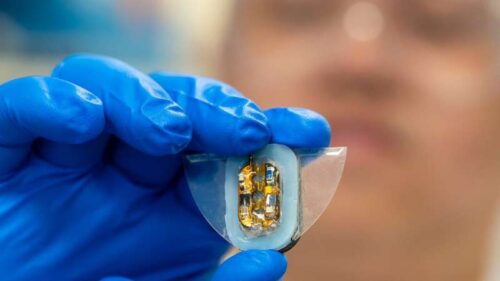
The team built flexible zinc-manganese dioxide (Zn-MnO₂) batteries in silicone and stacked them vertically inside a manta ray–inspired robot body. Vertical stacking saves space and keeps the robot flexible. The manta ray design allows coordinated movement, sensing, and energy use in a compact layout.
Tests showed that magnetic fields from the robot’s actuators stabilized battery chemistry, reduced dendrite growth, and maintained energy output under bending and stress. With magnetic enhancement, batteries retained 57.3% capacity after 200 cycles, nearly double that of unenhanced batteries. The effect comes from redirecting zinc ions for even deposition and aligning electron spins in the manganese oxide lattice to prevent crystal damage. This dual stabilization offers a way to provide durable onboard power.
To demonstrate the approach, a manta ray robot was built with flexible batteries, magnetic actuators, and a hybrid circuit for sensing and wireless communication. Its fins flap in response to magnetic fields, enabling movement across water surfaces. The same fields that drive motion also enhance battery stability. The robot can swim, turn, follow complex paths, and send data to a digital twin system.
The robot responds to obstacles autonomously. Inertial sensors detect acceleration changes, prompting adjustments in orientation and navigation. Feedback algorithms correct yaw, pitch, and roll caused by waves or contact, while temperature sensors map environmental conditions. Vertical integration of actuation, sensing, and power maximizes space without reducing flexibility, allowing the robot to move, sense, and respond in real time.
Future plans include adding miniature sensors, such as ultrasonic and chemical detectors, and applying magnetic enhancement to other battery types or forms like wearable fibers. The goal is soft robots that operate autonomously in complex or inaccessible spaces, from pipeline inspection to marine monitoring or medical tasks, achieving energy-efficient embodied intelligence inspired by natural designs.