A new ultra-compact, sub-1 V timing oscillator aims to shrink power budgets and PCB footprints in space-constrained devices such as wearables, AR/VR headsets, and dense IoT modules.
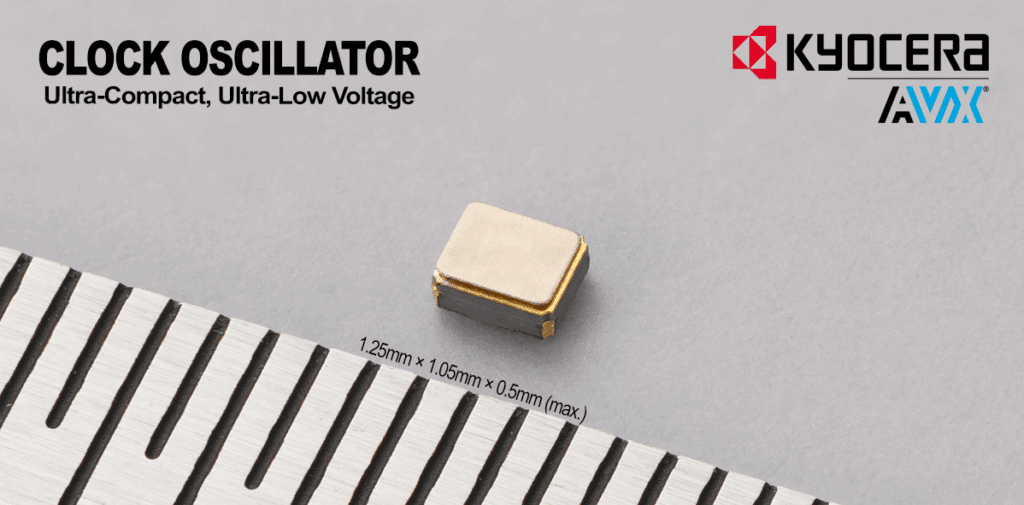
Kyocera AVX has introduced a new member to its crystal-device portfolio: the KC1210A Series clock oscillators, engineered for ultra-compact, low-voltage applications in next-gen devices. This series targets markets ranging from smartphones and wearables to VR headsets, IoT modules and beyond.

At the heart of KC1210A lies a newly developed low-voltage oscillator IC, enabling operation at a mere 0.9 V roughly 50% lower than the supply voltage of Kyocera’s earlier oscillators. Combined with a ceramic-packaged form factor measuring only 1.25 mm × 1.05 mm × 0.5 mm maximum, the KC1210A asserts itself as among the smallest clock oscillators of its kind globally.
The key tech features are:
- Ultra-low operating voltage
- Ultra-miniature footprint:
- Wide frequency range
- Low power draw
- High stability across temperatures
The compact design is not merely for bragging rights. Using proprietary compact-element design technology, the new oscillator trims the mounting area to just 1.31 mm² about a 60% reduction compared with previous offerings. Compared to the older KC2016K model, KC1210A’s volume is roughly one quarter, making it a compelling choice for space-constrained, high-density PCBs.
From a performance perspective, the Series delivers clock signals in the 9.6 MHz to 100 MHz range, with CMOS output and supply-voltage flexibility between 0.8 V and 1.8 V. At 50 MHz, typical current consumption is 3.5 mA under a 0.9 V supply (CL = 15 pF). Frequency tolerance is specified as ±25 ppm over –40 °C to +85 °C, widening to ±50 ppm when extended to –40 °C to +105 °C, to accommodate applications requiring broader temperature resilience.
The impetus behind this development: modern devices, smartphones, wearables, VR/AR headsets, IoT modules increasingly demand higher performance, tighter integration, and lower power consumption. As computational load, AI processing and wireless communication push circuits harder, power budgets shrink and board real estate gets tighter. A low-voltage, ultra-small oscillator like this helps designers meet these constraints without compromising timing stability.
With broad applicability across consumer electronics and IoT, the series positions Kyocera AVX to address the growing need for energy-efficient, miniaturised timing components especially as devices get smarter, denser, and power-sensitive.