A compact 402 nm laser pushes power and lifespan higher without expanding its footprint.
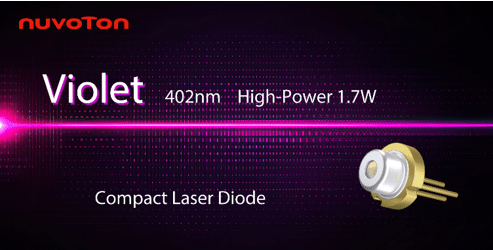
A new high-power violet laser diode is redefining design by Nuvoton Technology limits for compact optical systems by delivering 1.7 W of output at a 402 nm wavelength while staying inside the tightly constrained TO-56 CAN package. The achievement matters because short-wavelength lasers traditionally struggle to balance power, thermal performance, and package size. With more industries shifting toward smaller, energy-efficient light engines, the ability to raise optical power without enlarging the module represents a meaningful shift in component capabilities.
The key features are:
- 1.7 W optical output at 402 nm in a standard TO-56 CAN package
- Optimized chip structure reduces internal optical loss and heat generation
- Reinforced facet design boosts durability and extends MTTF
- ~40% higher output compared to previous same-package violet lasers
- Suitable for LDI, curing, 3D printing, biomedical, and mercury-lamp-replacement systems
The diode’s performance stems from an evolved chip structure built to reduce internal losses, which directly cuts heat generation as power rises. Excess heat has long been the key obstacle for higher-powered violet sources, typically forcing designers to adopt larger heatsinks or switch to bulkier packages. By optimizing optical pathways and improving thermal dispersion at the chip level, the new device avoids that trade-off. A reinforced facet architecture enhances resistance to strong light densities, raising durability and significantly improving lifetime metrics such as MTTF. That makes the diode well-suited for applications that demand continuous or long-cycle operation.
The resulting output marks an estimated 40% jump compared to earlier 402 nm lasers in the same package class. This opens new design flexibility for Laser Direct Imaging systems, which require high-intensity, highly stable violet light to expose fine circuit patterns. Resin-curing modules and 3D-printing engines both increasingly dependent on compact, high-power photonic sources stand to benefit from the smaller footprint and longer operating life. Biomedical instruments and compact display subsystems, where space, heat, and reliability are critical engineering constraints, also gain new options.
The diode also strengthens the momentum behind solid-state replacements for mercury lamps. Operating near the h-line region, it fits into multi-wavelength architectures that combine violet, UV, and indigo lasers to emulate traditional lamp behavior. This offers system makers a path toward lower maintenance, faster startup times, and more stable optical output. By expanding power density within a standard package, the new violet laser positions itself as a core component for next-generation optical engines. With volume production planned for early 2026, it arrives as designers across imaging, curing, manufacturing, and biomedical sectors seek compact sources that deliver both performance and durability.