

A new micropower linear Hall sensor targets extended battery life and precision motion feedback in gaming peripherals, IoT interfaces, and industrial systems.
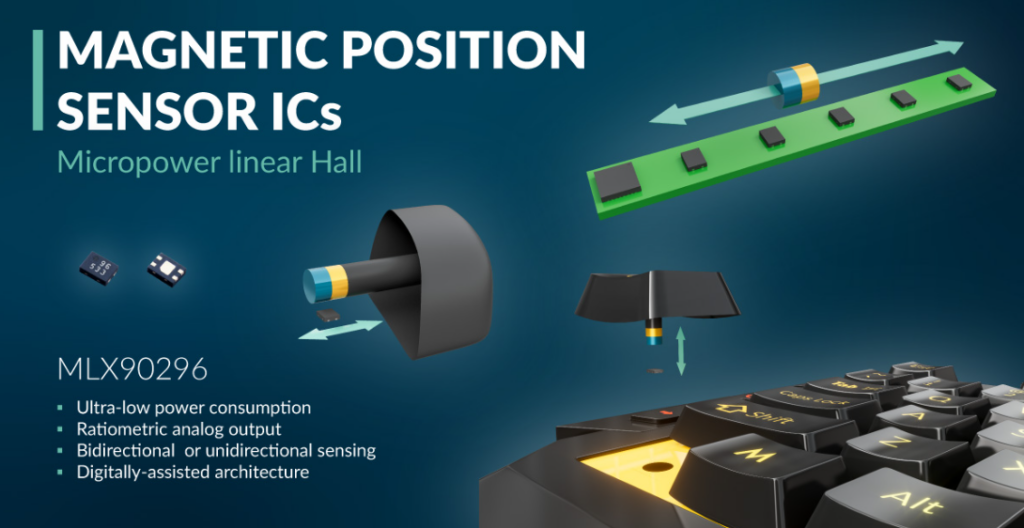
Melexis has launched an ultra-low-power linear Hall-effect sensor designed to tackle key challenges in modern motion-sensing applications chiefly power efficiency, compact integration, and stable signal quality for battery-driven and space-constrained designs. The latest device draws minimal current while delivering precise contactless linear position measurements, positioning it as a strong candidate for next-generation gaming, consumer IoT, and industrial interfaces.
The key features are:
- Ultra-low power draw: Standby current ~7 nA; ~5 µA at 100 Hz enable rate.
- Fast enable response: ~25 µs typical enable time.
- Digital filtering with selectable sensitivity: Enhances accuracy and SNR.
- Supports bipolar and unipolar magnetic operation: Flexible for various magnetic layouts.
- Compact footprint & wide temperature range: DFN-4L package, −40 °C to 105 °C.
At the core of the new sensor is its micropower architecture, which dramatically lowers energy draw compared with traditional potentiometers and legacy Hall devices. With standby currents measured in the nanoamp range and only a few microamps at typical enable rates, this device extends operational lifetime in battery-powered systems, a critical requirement for handheld controllers, keyboard interfaces, and remote sensors.
In addition to its energy credentials, the sensor incorporates on-chip digital filtering and multiple sensitivity options. These features improve the signal-to-noise ratio and allow designers to choose settings that best match their mechanical and magnetic configurations, enabling either smaller magnets or increased sensing range without sacrificing accuracy. The digital path also contributes to more repeatable measurements over temperature and supply variations.
Flexible magnetic polarity support offering both bipolar and unipolar operation gives system designers more freedom in magnet placement and orientation, further broadening potential application use cases from joysticks and linear controls to fluid level monitoring and industrial actuators.
Physically, the device is housed in a tiny DFN-4L package suitable for dense board layouts, operates from a low-voltage supply, and maintains performance across a wide temperature range. Multiple pre-configured variants streamline design-in and shorten time to market for new products. This new micropower linear Hall sensor thus provides a balanced blend of power efficiency, measurement quality, and integration flexibility for designers working across gaming, IoT, and industrial segments.