






Managing multiple lights, sensors, and controls can be messy. This design can make it simple and lets you easily set up smart, flexible lighting.
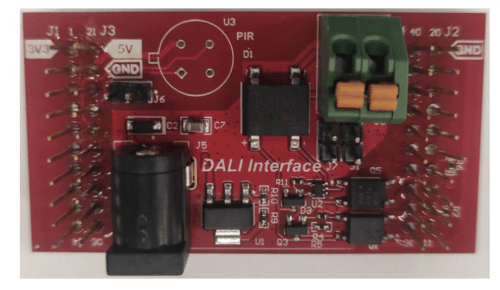
Design engineers face several challenges when implementing modern lighting systems. They need to manage multiple light sources and control devices reliably while integrating sensors, switches, and user interfaces. Traditional analog systems like 0–10V or 1–10V are prone to wiring mistakes, difficult to reconfigure, and limited in flexibility. Engineers also need standardized solutions that meet hardware and software requirements to ensure interoperability, support automated control, and handle complex setups such as daylight sensors, exit and emergency lighting, or wired control systems.
TIDA-010963, the reference design from Texas Instruments (TI) uses an MCU to implement a Digital Addressable Lighting Interface (DALI) 103, addressing these challenges. It meets IEC 62386-103 hardware and software requirements and includes a configurable DALI transceiver, power supply, isolation, and firmware for reliable advanced lighting control. The design supports applications such as daylight sensors, exit and emergency lighting, lighting sensors, and wired control setups.
The DALI bus carries both power and data on the same pair of wires, simplifying wiring and reducing errors. Each DALI subnet can support up to 64 control gears and 64 control devices. Control gears provide power to LEDs and other light sources, including fluorescent lamp ballasts and self-contained emergency lighting devices. Control devices include application controllers, sensors, switches, and push-buttons. A bus power supply is required, typically delivering 16V and up to 250mA. Application controllers often include a gateway to external networks.
Input devices provide user or environmental information to the lighting system. They include sensors for automated control and interfaces for user adjustments, such as dimming, color, or scene selection. Examples include push-buttons, sliders, occupancy sensors, and light sensors. Input devices generally operate in a multi-controller setup and are mostly event-driven, though polling is also possible. This system uses Passive Infrared (PIR) sensors as an example of input devices.
Application controllers act as the central logic units of a DALI system. They process information, make decisions, and send commands to control gear. Controllers can use data from control gear, input devices, other controllers, or external systems. This reference design uses the MSPM0 microcontroller as the application MCU.
DALI is a half-duplex digital communication system using forward and backward frames. Forward frames include one start bit, one address byte, one data byte, and two stop bits. Backward frames, sent in response to queries or memory commands, consist of one start bit, one data byte, and two stop bits. The protocol uses Manchester encoding, with interface voltages ranging from 11.5V to 22.5V.
DALI simplifies the installation of flexible, scalable lighting networks. It was developed to digitally control and configure fluorescent ballasts, replacing the one-way operation of 0–10V or 1–10V analog systems. While broadcast control is still possible, each DALI device can be individually addressed for precise digital control. Devices can also be grouped, enabling software-based reconfiguration without rewiring. This allows different lighting functions or moods across rooms or areas to be easily adjusted and optimized.

