





This project presents a secure, low-cost electronic voting system using Arduino Uno, an R305 fingerprint sensor, a keypad-based button interface, and an LCD display. Voters authenticate via fingerprint and can vote only once by selecting a candidate using dedicated push buttons, with a buzzer confirming successful vote registration. Vote counts remain hidden until the authorised administrator authenticates to reveal results. The system prevents duplicate voting, enhances transparency, and is suitable for institutions, campuses, housing societies, and small-scale elections, with scalability possible by upgrading the controller hardware.
POC Video Tutorial
A secure electronic voting system with real-time authentication and keypad enables accurate, tamper-proof voting through identity verification and controlled access. Voters authenticate using unique credentials before casting votes through a keypad interface. The system enhances transparency, prevents duplication or fraud, and records votes securely, making the electoral process faster, more reliable, and suitable for modern democratic environments.
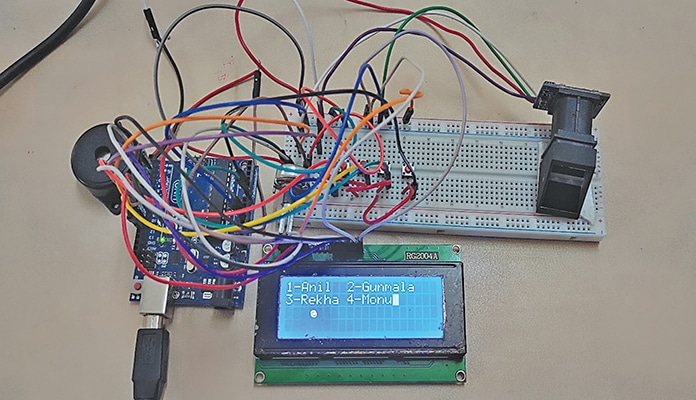
The system offers a secure, efficient, and practical biometric voting approach by combining fingerprint authentication with keypad-based candidate selection. The prototype is shown in Fig. 1, and the components used are listed in the Bill of Materials table.
| Bill of Materials | |
| Components | Quantity |
| Arduino Uno (MOD1) | 1 |
| R305 fingerprint sensor (MOD2) | 1 |
| 20×4 LCD display (LCD1) | 1 |
| Push-to-on switch (SW1-SW4) | 4 |
| Buzzer (B1) | 1 |
| 10k potmeter (R1) | 1 |
| Breadboard | 1 |
| USB cable | 1 |
Electronic Voting System Circuit and Working
Fig. 2 shows the circuit diagram of the electronic voting system. It employs an Arduino Uno, an R305 fingerprint sensor, a 20×4 LCD display, four push buttons, and a buzzer to support a tamper-proof and user-friendly voting process. Each of the 14 authorised users (10 voters and 4 candidates) is pre-registered and permitted to vote only once.
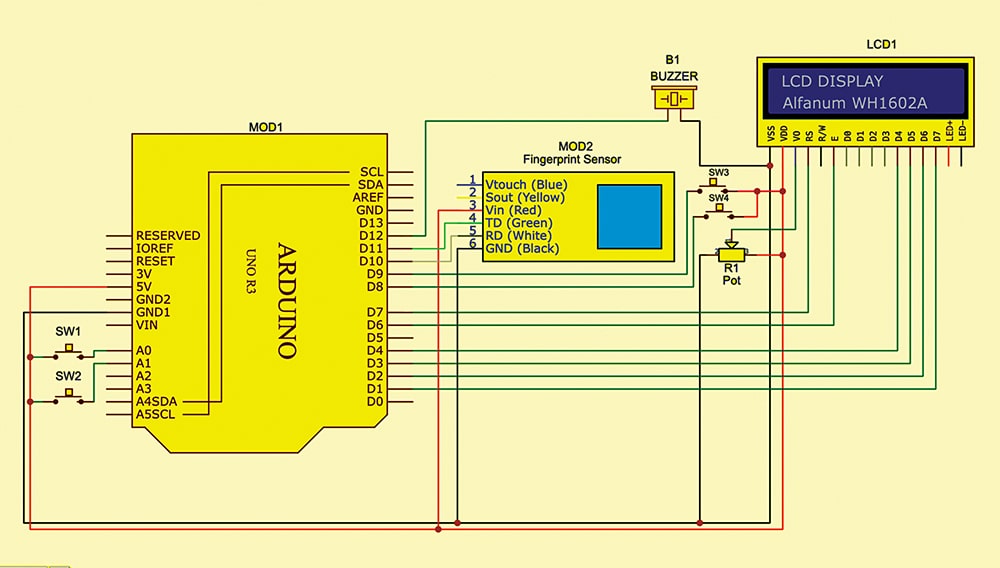
(EFY note: A 20×4 LCD with a 4/8-bit interface has been used in this system. It may be replaced with a 16×2 I2C LCD to reduce wiring. In such a case, the code must be adjusted accordingly. The system has also been tested with an I2C display and found to work reliably.)

After successful fingerprint authentication, the system displays the voter’s name on the LCD and prompts the selection of one of four candidates: Anil, Gunmala, Rekha, or Monu. A buzzer confirms that the vote has been recorded. The vote count remains concealed until the authorised administrator (Rakesh Jain) authenticates via fingerprint, after which the final tally is displayed.
Pressing the Arduino reset button clears previous data and reinitialises the system. This prevents duplicate voting and supports transparency, making the system suitable for institutional voting, small-scale elections, and pilot e-governance implementations. Its simplicity and low hardware requirements contribute to practicality and ease of deployment.
The system operates through three main processes: Fingerprint enrolment, fingerprint deletion, and the main voting process. User fingerprints are added using the fingerprint enrolment sketch software. When removal is required, the fingerprint deletion sketch erases stored fingerprint templates.
The main voting program manages the voting sequence. The system includes one administrator (Rakesh Jain), four candidates (Anil, Gunmala, Rekha, and Monu), and ten registered voters (Niket, Garima, Sonu, Neetu, Tinu, Vikas, Chintu, Sarita, Harita, and Deepak). Each voter is permitted to vote once, and the administrator does not participate in voting.
After authentication, the LCD displays:
“WELCOME (NAME) VOTE NOW…”
The voter selects a candidate using one of four push buttons connected to pins 8, 9, A0, and A1. The buzzer connected to pin 12 sounds briefly to confirm recording. The system tracks fingerprint IDs to ensure that no user votes more than once.
When all votes have been cast, the administrator authenticates to view the final results.
Biometric Electronic Voting Machine: Working Steps



very good