Learn how researchers demonstrate a single platform that generates and detects femtosecond UV C laser pulses using nonlinear optics and two dimensional semiconductor photodetectors.
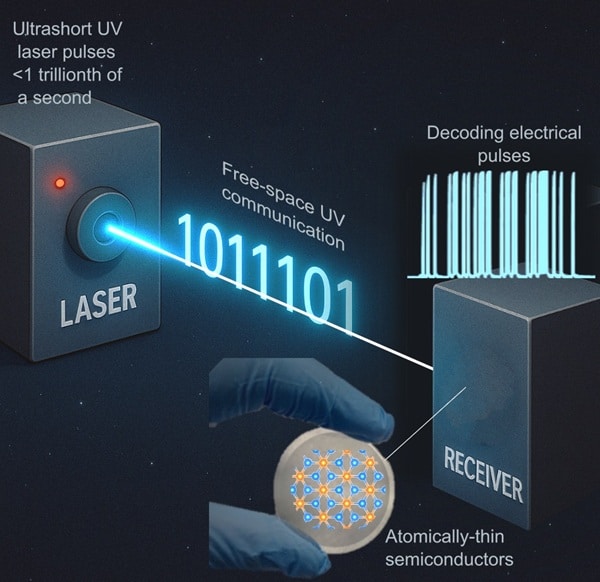
Ultraviolet C light is widely used in disinfection, high contrast imaging and the study of ultrafast molecular dynamics due to its strong interaction with organic materials. Despite this potential, wider use of UV C technology has been limited by the lack of compact light sources and fast detectors capable of operating on femtosecond timescales.
To address this gap, researchers from the University of Nottingham and Imperial College London have demonstrated an integrated platform that both generates and detects femtosecond UV C laser pulses. The system combines nonlinear optical crystals for pulse generation with photodetectors based on two dimensional semiconductors, enabling generation and detection within a single architecture.
The source is based on phase matched second order nonlinear optical processes. Using cascaded second harmonic generation in optimized nonlinear crystals, the system produces the fourth harmonic of a femtosecond near infrared laser. UV C pulses are delivered with energies of up to about 2 microjoules and achieve around 20% conversion efficiency from near infrared to UV C.
Detection is performed at room temperature using photodetectors fabricated from gallium selenide and gallium oxide. These materials provide fast temporal response and low power operation. The detectors show stable performance across a wide range of pulse energies and repetition rates, a capability not previously demonstrated using conventional semiconductor technologies.
Key features of the research include:
- Femtosecond UV C pulse generation through cascaded harmonic processes
- UV C pulse energies up to approximately 2 microjoules
- Around 20% conversion efficiency
- Room temperature detection using two dimensional semiconductors
- Fast temporal response and low power operation
- Reliable detection across varying pulse energies and repetition rates
Amalia Patané, Professor of physics, University of Nottingham says, “This work combines for the first time the generation of femtosecond UV C laser pulses with their fast detection by a new class of two dimensional semiconductors.”
The researchers demonstrated a free space communication system in which information was encoded using the UV C source and decoded by the two dimensional semiconductor detector later as a proof of the concept.