Read on to know how researchers develop a sensory skin that helps robots feel damage and pull away from harmful contact in real time.
As humanoid robots move beyond factories into homes, hospitals and public spaces, safety and intuitive interaction have become critical challenges. Unlike humans, robots typically process touch through centralized systems, creating delays that can lead to damage when encountering sharp, hot or harmful objects. Researchers are increasingly looking for ways to give machines faster, more instinctive responses similar to human reflexes.
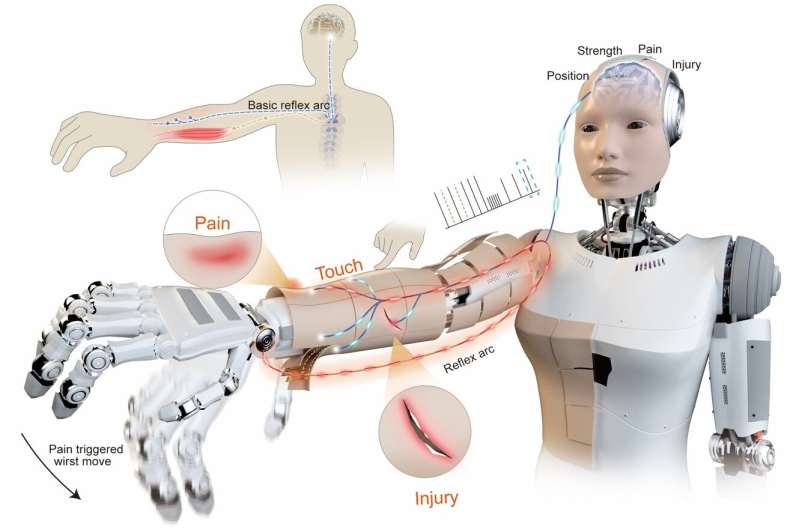
To address this need, researchers from the City University of Hong Kong (CityUHK) and the Southern University of Science and Technology have developed a neuromorphic robotic electronic skin that allows humanoid robots to sense touch, detect injury and react to potentially painful contact almost instantly. The work introduces a nervous system inspired approach to robotic sensing, enabling machines to respond before centralized processing takes place.
The neuromorphic e skin mimics how human skin and nerves handle sensory information. Built as a four layer structure, the outer layer acts as a protective surface, while underlying layers sense pressure, force and structural damage. Tactile inputs are converted into electrical pulse trains resembling biological nerve signals. Even in the absence of contact, the skin sends regular pulses to indicate normal operation. If the skin is cut or damaged, these signals stop, allowing the robot to detect both the injury and its location.
Crucially, the system supports reflex-like responses. When applied force exceeds a pre-set threshold, a high voltage signal is sent directly to the robot’s motors, bypassing the central processor and triggering immediate withdrawal. The skin is also modular, using magnetic patches that can be quickly replaced to simplify maintenance.
Key features of the e-skin include:
- Neuromorphic architecture inspired by human skin and nerves
- Real time detection of touch, damage, and injury location
- Direct motor triggering for rapid reflex responses
- Modular design enabling fast repair and replacement
The researchers conclude that this neuromorphic e-skin significantly improves robotic touch, safety and intuitive human robot interaction, marking an important step toward more empathetic and resilient service robots.