Thin devices need faster storage but face limits in cost, power, and space. A new approach shows how speed can fit small designs without extra heat or cost.
Many notebook and mobile PC makers want PCIe Gen5 storage, but face three limits: cost, power, and space. Gen5 controllers add heat, need DRAM, and require thicker or double-sided SSD designs. This makes them hard to use in thin laptops, handhelds, and compact systems.
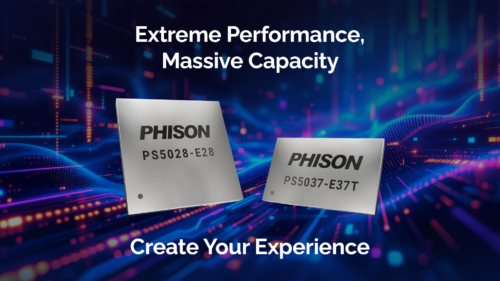
Phison Electronics is addressing this gap with the E37T PCIe Gen5 controller. It is built for teams designing consumer devices that need Gen5 speeds within cost and power limits.
The E37T targets cost-sensitive designs. It uses a DRAM-less, 4-channel architecture and supports 3D NAND up to 4800 MT/s. This lowers BOM cost and board complexity while delivering up to 38% higher performance than earlier generations. Running without external DRAM and with fewer channels also reduces power use and heat.
For system designers, this allows simpler SSD layouts. The controller supports single-sided SSDs and M.2 form factors such as 2280, 2242, and 2230. This suits thin notebooks, handheld devices, and systems where double-sided SSDs cannot be used.
In use, the E37T is aimed at consumer workloads. It reaches up to 14.7 GB/s read, 13.0 GB/s write, and up to 2 million 4KB random IOPS, while keeping active power below 2.3 W. This fits laptops and mobile platforms with thermal limits.
“As consumer applications demand greater storage capacity and sustained performance in small spaces, the E37T is designed to deliver power-efficient operation while pushing the Gen5 performance ceiling,” said Michael Wu, President & GM, Phison US. “With the next wave of platforms introducing PCIe Gen5 in smaller form factors, the E37T expands our portfolio with a versatile, high-value storage solution that brings faster, more responsive user experiences to a broad range of devices and use cases.”
This places the E37T below Phison’s E28 controller, which is built for gaming, workstation, and other systems. The E28 focuses on peak performance with an 8-channel design and DRAM cache, while the E37T focuses on making PCIe Gen5 SSDs usable in consumer devices.