Ultra-sensitive infrared detectors originally built for defense and telecoms are moving into premium hunting and long-range shooting optics, promising longer range and higher reliability.
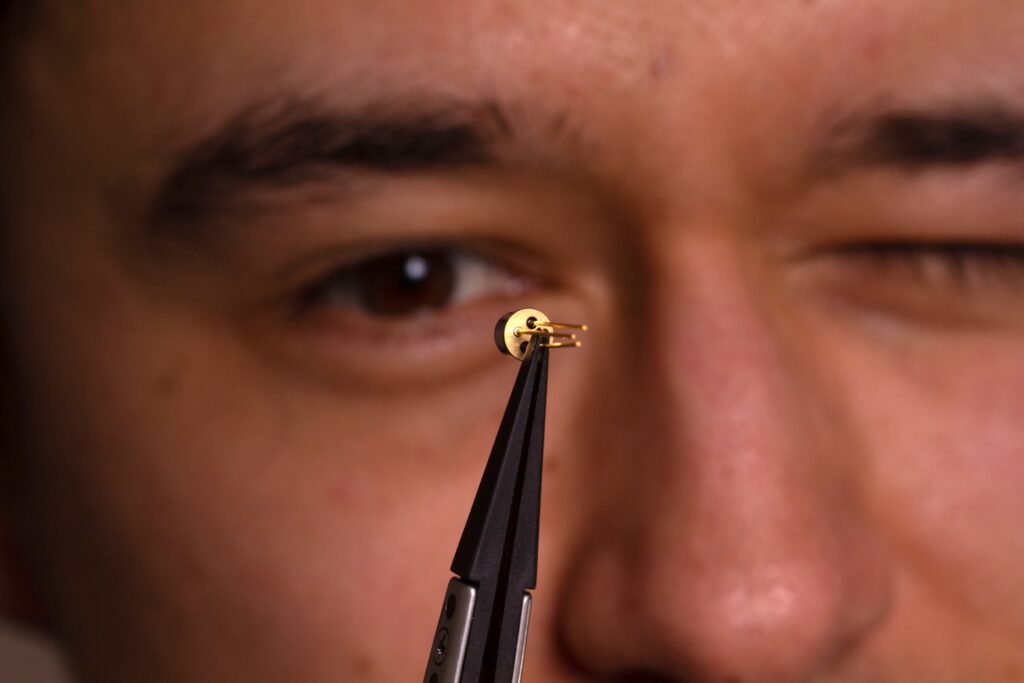
High-sensitivity infrared sensing technology by Phlux Technology, operating at 1550 nm is gaining traction beyond its traditional defense and telecom roots, with premium hunting and long-range shooting optics emerging as the next adoption wave. Sensor developers report growing interest from manufacturers of elite laser rangefinders, ballistic scopes, and low-light targeting systems seeking higher ranging accuracy under real-world field conditions.

The key features are:
- Optimized detection at eye-safe 1550 nm wavelength
- InGaAs APD architecture with ultra-low noise
- Order-of-magnitude higher sensitivity than standard NIR detectors
- Improved ranging in fog, low light, and low-reflectivity targets
- Supports longer range or smaller, lower-power optical designs
At the center of this shift is a new class of InGaAs avalanche photodiode (APD) sensors designed to detect extremely weak infrared return signals. Compared with conventional near-infrared detectors, these devices deliver roughly an order-of-magnitude improvement in sensitivity. That performance margin, already proven in military laser rangefinders and fiber-optic test equipment, is now being evaluated to address long-standing limitations in civilian and professional shooting optics.
The appeal lies largely in the 1550 nm operating wavelength. Unlike the widely used 905 nm band, 1550 nm is considered eye-safe at significantly higher laser powers, allowing optics designers to push effective ranging distances without violating safety regulations. Combined with ultra-low noise receivers, this enables more reliable detection of weak reflections from dark, poorly reflective, or partially obscured targets common scenarios in hunting and pest-control environments.
For system designers, higher receiver sensitivity also opens alternative design paths. Instead of extending range, manufacturers can reduce laser power, shrink optical assemblies, or lower overall system power consumption while maintaining existing performance. This is particularly relevant for compact binoculars, monoculars, and integrated digital scopes where size, weight, and battery life are tightly constrained.
Beyond stand-alone rangefinders, the technology is being explored for integrated fire-control optics that combine ranging, ballistic computation, and imaging. When paired with modern processing, highly sensitive 1550 nm receivers can support smart scopes that deliver more consistent range data in fog, drizzle, heat shimmer, and low-contrast terrain. Some developers are also assessing the wavelength for specialist professional systems that require illumination or aiming aids largely invisible to conventional night-vision devices.
Originating in mission-critical defense and telecom deployments, these sensors are designed for thermal stability, reliability, and long-term consistency attributes that translate directly into confidence for professional users operating in harsh outdoor conditions.