




0.24 mm² low-power FMCW design targets 6G sensing-communication convergence in edge electronics.
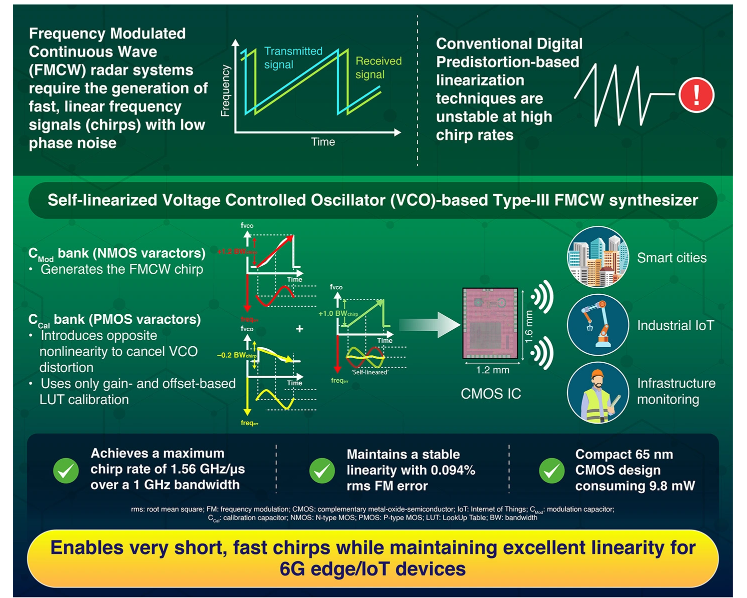
Tokyo scientists have unveiled a tiny radar-on-chip prototype that could reshape future wireless hardware for beyond-5G and 6G ecosystems, marrying sensing with communications in a power-lean design. Developed at Japan’s Institute of Science Tokyo, the new chip packs a high-precision Frequency-Modulated Continuous-Wave (FMCW) radar generator into a 0.24 mm² silicon footprint that runs on just 9.8 mW of power, a dramatic reduction compared with conventional radar hardware. That tiny size and energy draw make it well-suited for integration into edge devices and Internet of Things (IoT) modules where space and battery life are at a premium.
At the heart of the design is a self-linearized synthesizer architecture, which embeds linearization directly into the oscillator hardware. This approach sidesteps the traditional tradeoffs between chirp speed and linearity that have long constrained radar-based sensing, particularly in compact circuits. The prototype achieved a 1 GHz bandwidth with sub-0.1 % error while operating at approximately 9.7 GHz, performance metrics that signal readiness for accurate motion and range detection in compact form factors.
One of the key motivations behind such miniaturized radar chips is the push toward Integrated Sensing and Communication (ISAC) systems architectures that combine wireless data transmission with environmental sensing abilities. ISAC is viewed as a pillar of future wireless connectivity standards, enabling smart cities, industrial automation, and large-scale connected sensors to communicate and detect surroundings with a single hardware platform.
The research team plans to showcase this chip at the 2026 IEEE International Solid-State Circuits Conference (ISSCC) in San Francisco, one of the industry’s flagship events for semiconductor and integrated circuit innovation.
If commercialized, this class of ultra-compact radar hardware could help reduce the cost, complexity, and energy footprint of next-generation edge systems while unlocking new use cases in automotive safety, robotics, wearables, and beyond sectors where tight integration of sensing and wireless data links is increasingly essential.


