





Hardware-in-the-loop setup combines ray tracing, full 5G stack and AI inference to test next-gen RAN features entirely inside the lab.
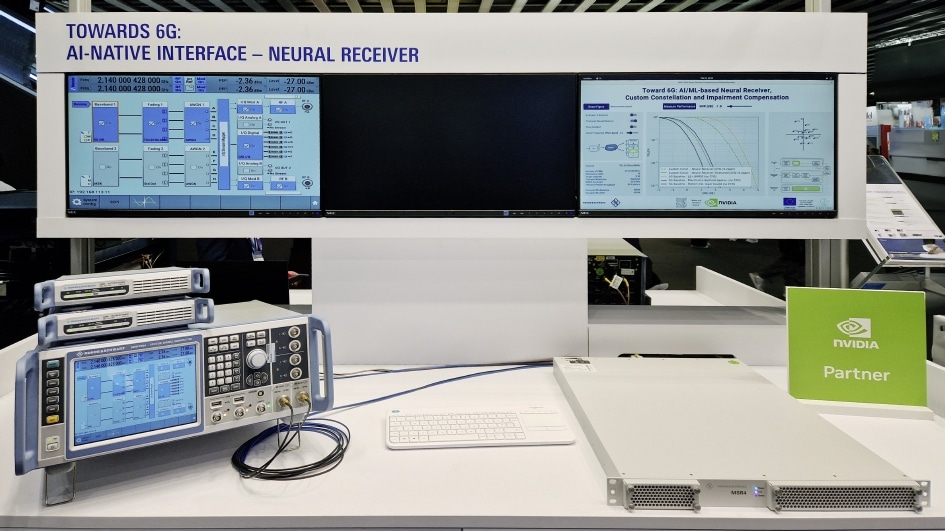
Rohde & Schwarz and NVIDIA will demonstrate a digital twin-based AI-RAN testbed designed to move validation of 5G-Advanced and early 6G concepts from simulation to system-level, hardware-in-the-loop testing.

The setup integrates site-specific channel emulation with the NVIDIA Sionna Research Kit, enabling researchers to evaluate AI-driven radio access network features under realistic propagation conditions without leaving the lab. The companies say the approach bridges the gap between AI-based wireless simulations and real-world deployment scenarios.
The key features are:
- Hardware-in-the-loop testing using site-specific digital twin channel emulation
- Integration of differentiable ray tracing with full 5G NR protocol stack
- Real-time AI inference on a single DGX-class compute platform
- AI-driven link adaptation with dynamic MCS optimization
- Closed-loop RF validation using high-end signal generation and analysis tools
Unlike earlier proof-of-concept demonstrations focused on neural receiver design and custom constellations, the new platform advances to full system-level verification. It runs a software-defined 5G RAN based on OpenAirInterface and supports AI inference workloads under strict real-time constraints, powered by a single NVIDIA DGX Spark.
A key highlight is an AI/ML-enhanced link adaptation algorithm embedded into the end-to-end system. The algorithm dynamically adjusts downlink modulation and coding schemes to optimize spectral efficiency and reliability. It can learn both site-specific propagation effects and user equipment behavior in real time, underscoring the importance of closed-loop, system-level AI-RAN validation.
On the RF side, the testbed combines the R&S SMW200A vector signal generator and the R&S FSW signal and spectrum analyzer. Together, they emulate complex, site-specific radio channels and interface with Sionna’s differentiable ray-tracing engine to create a fully closed-loop environment.
The companies position the platform as a foundation for prototyping and validating AI-native base station features for future 5G-Advanced and 6G networks, where digital twins and synthetic data are expected to play a growing role in training and testing.


