A solid battery completed a second test, working at 100°C and delivering higher capacity, while claims on energy density and cycle life remain unproven.
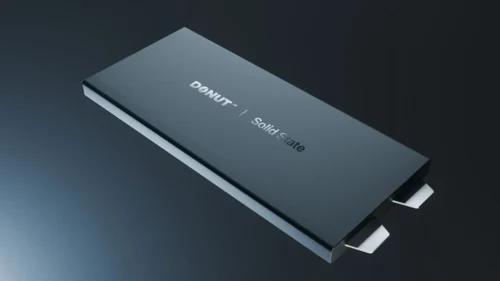
Donut Lab’s solid-state battery has now passed two independent tests, but its biggest claims remain unproven. In the latest report, VTT Technical Research Centre of Finland confirmed that the company’s cell can discharge at temperatures up to 100°C. At both 80°C and 100°C, the battery delivered more capacity than it did at room temperature. That supports part of Donut Lab’s claim that the battery operates safely across a wide temperature range.
The battery tested was labeled “Donut Solid State Battery V1,” rated at 26 Ah and 94 Wh at 3.6 V. At 20°C, it delivered 24.9 Ah at a 1C rate (24 A), slightly below nominal. At 80°C, discharged at the same 24 A rate, it delivered 27.5 Ah — about 110% of its room-temperature result. At 100°C, discharged at 12 A, it delivered 27.6 Ah — about 107% of the reference capacity at that current. After both tests, the cell was recharged at room temperature and functioned normally.
High-temperature stability is significant. Conventional lithium-ion cells can degrade rapidly or face safety risks at such temperatures. Solid-state batteries behave differently because they do not use a flammable liquid electrolyte. Ionic conductivity can improve as temperature rises, which may explain the higher discharge capacity.
There was one concern. After the 100°C test, VTT observed that the pouch had lost its vacuum. The battery still worked, but the outgassing suggests either a materials issue or a sealing limitation at extreme temperature. The report does not identify the cause.
This is the second independent result released in two weeks. In the previous report, VTT confirmed that the same battery could charge from 0 to 80% in 4.5 minutes. Together, the two tests validate fast charging and high-temperature discharge performance.
However, several major claims remain unchecked. Donut Lab says the battery reaches 400 Wh/kg energy density. The tested cell is rated at 94 Wh. To meet 400 Wh/kg, it would need to weigh roughly 235 grams. The VTT report does not list the cell’s mass, so the energy density claim cannot be verified.
The company also claims a cycle life of 100,000 charge-discharge cycles. For comparison, most commercial lithium-ion cells reach 1,000 to 5,000 cycles. Even leading solid-state developers report far lower validated numbers. Proving 100,000 cycles would require long-term independent testing.
Cold performance has also not been confirmed. Donut Lab says the battery retains more than 99% capacity at -30°C, but the VTT tests did not include low-temperature operation. Cost is another open question. The company says the battery will be cheaper than lithium-ion and use green, abundant materials. No third-party cost analysis has been published