

Electronics-driven control system keeps satellites steady during in-orbit servicing.
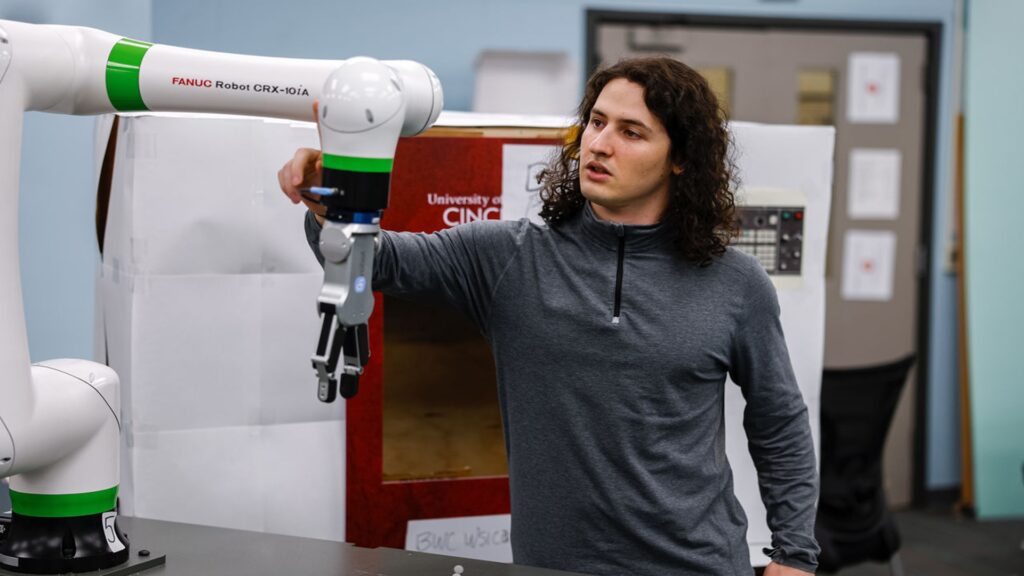
Engineers have developed a dual-arm robotic system designed to keep satellites stable while performing delicate repairs in orbit, potentially extending satellite lifespans and reducing space debris. The concept uses an electronically controlled balancing technique in which one robotic arm performs repair work while the second arm automatically counteracts motion to maintain stability.
Specifically, researchers at the University of Cincinnati in the United States conducted research within the College of Engineering and Applied Science on aerospace robotics. They created the approach after recognising a key challenge in space robotics: physical contact between a repair robot and a satellite can cause both objects to drift or spin in microgravity. Even a small bump during maintenance could destabilise the spacecraft, making accurate repairs extremely difficult. The work was led by graduate student James Talavage and Professor Ou Ma, who study robotic systems designed for in-orbit satellite servicing and repair. Their research focuses on improving robots’ ability to maintain orientation and stability while interacting with satellites in microgravity.
To solve this, the team designed what they call a Dual-Arm Zero Momentum strategy. Inspired by the way bull riders use a free arm to maintain balance, the system uses the robot’s second arm to generate counteracting inertia. When the primary arm moves to manipulate a satellite component, the secondary arm adjusts its motion to offset any rotational forces affecting the robot and the satellite.
Simulations of in-space servicing, assembly, and manufacturing tasks showed that the balancing arm can autonomously correct unwanted yaw, pitch, or roll caused by the repair operation. This electronic control technique helps maintain the orientation of both the servicing robot and the target satellite during contact operations.
Maintaining stable orientation is a major challenge for free-floating space robots because the motion of their manipulators is dynamically coupled with the spacecraft base. Without proper control, arm movements can disturb the spacecraft’s attitude and disrupt operations. The research team presented the concept at the American Institute of Aeronautics and Astronautics SciTech Forum, with support from the U.S. Space Force. According to the researchers, the approach could work with existing robotic hardware used for orbital servicing missions. In-orbit servicing robots are increasingly viewed as essential infrastructure for future space operations. Robotic repair systems could fix malfunctioning satellites, upgrade aging spacecraft, or even help remove debris from crowded orbits. If successfully implemented in real missions, dual-arm robotic systems with advanced electronics control could enable safer satellite maintenance and reduce the need for risky astronaut spacewalks.